
Pittsburgh winters are hard on outdoor concrete, and stairs take the worst of it. Every set of front steps in Allegheny County has to deal with freezing rain, packed snow, road salt tracked up from the curb, and meltwater that runs down the treads and refreezes overnight into a sheet of ice. Concrete stairs are more vulnerable than a flat slab because each step has a tread, a riser, and at least one open edge, which means water has more ways to get in and cold has more surface area to work through. The damage almost never shows up after a single storm; it builds quietly over several seasons until the front lip of a tread starts crumbling under foot or a corner breaks clean off. Early fall is the right time to get ahead of the problem, while daytime temperatures are still warm enough for sealers to cure correctly and patching material to gain strength before the first hard freeze. This guide walks through what ice actually does to concrete stairs, the steps that stop the damage before it starts, and how to tell when a set of steps has gone past the point of repair.
What Ice Does to Concrete Stairs During a Pittsburgh Winter
Concrete looks solid, but it is a porous material with a network of tiny capillaries running through the cement paste. Water moves into those pores during rain, snowmelt, and humid weather, and it sits there until something forces it out. When that trapped water freezes, it expands by roughly nine percent and pushes outward against the surrounding paste with real force. One cycle does almost nothing you can see. Pittsburgh, however, regularly runs through fifty or more freezing and thawing cycles in a single winter, and the region sits right in the temperature band where the surface of a step can thaw in afternoon sun and refreeze after dark on the same day. Stairs collect the meltwater from everything above them, so they stay wetter and refreeze faster than the driveway or the walkway leading to them.
How Ice Damages Concrete Stairs One Layer at a Time
The first thing to understand is that ice damage on concrete stairs starts at the surface and works down. Water saturates the top few millimeters of the tread, freezes, and pops loose a thin sheet of cement paste along with some fine sand. Contractors call this scaling, and in its early stage it looks like the step has gone from smooth to slightly rough and sandy. Homeowners often mistake it for normal wear or dirt buildup and sweep it off without a second thought. Once that top layer is gone, the concrete underneath is more porous than the original finished surface was, so it absorbs even more water during the next storm. The following winter, that same step loses a thicker layer, and by the third or fourth season the aggregate is exposed and the tread has a visible dished look where feet land most often.
The second stage is spalling, and it usually shows up at the nose of the tread first. The nose is the front edge that overhangs the riser below it, and it is the most exposed part of any concrete step because cold air reaches it from the top, the front, and the underside all at once. Water wicks into that edge, freezes faster than the rest of the step, and eventually breaks off chunks that range from the size of a quarter to the size of a dinner plate. A spalled nose is not only ugly; it changes the effective depth of the tread and creates a trip point exactly where people plant their weight. If the stairs were built with reinforcing steel set too close to the surface, the exposed rebar begins rusting once the cover concrete breaks away, and rust occupies several times the volume of the original steel, which pries the step apart from the inside.
The third stage involves the structure of the stairs rather than the surface. Poured stairs sit on a base of compacted stone or soil, and that base holds moisture just like the concrete does. When the ground freezes, it heaves upward, and different parts of the stair footprint heave by different amounts depending on soil moisture and depth. That differential movement cracks stairs across the treads, separates them from the porch or the sidewalk they connect to, and opens joints that then fill with more water. Once a crack runs through a step, every freeze widens it a little further, and the process accelerates because a wide crack collects far more water than a hairline one. At that point you are no longer dealing with a cosmetic issue; you are dealing with a step that can shift under load.
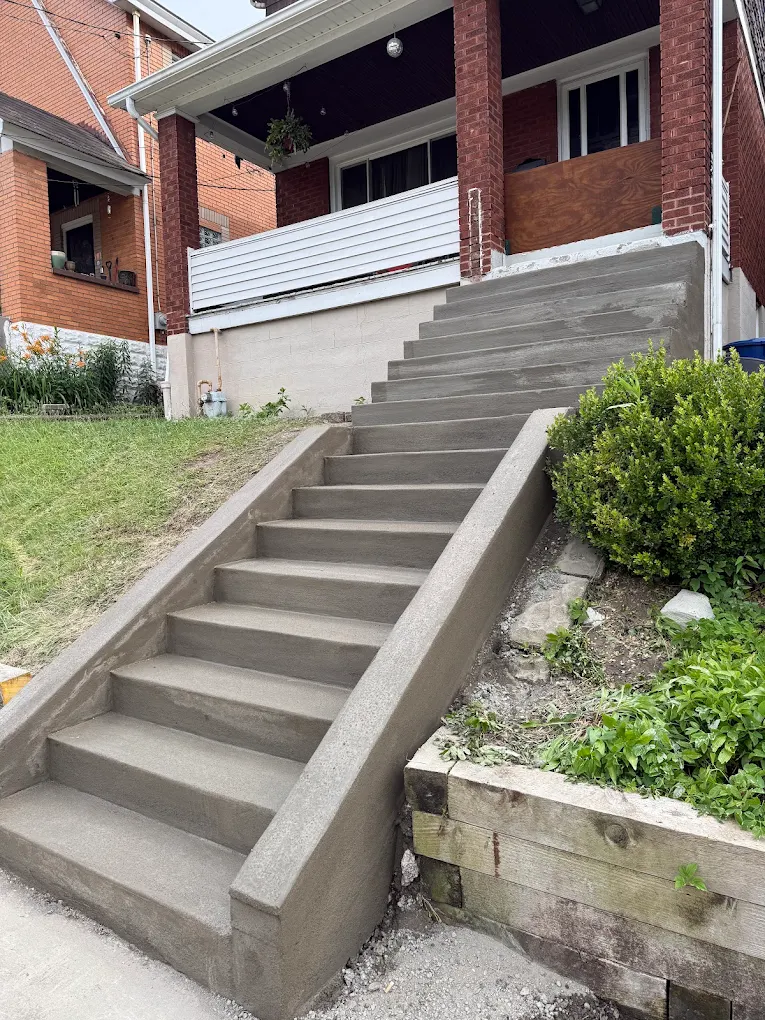
Why Deicing Salt Makes Ice Damage on Concrete Stairs Worse
Most homeowners reach for rock salt the moment the forecast mentions freezing rain, and it is worth knowing exactly what that product does to concrete stairs. Sodium chloride, the common white rock salt sold at every hardware store in the region, does not chemically dissolve concrete the way some people assume. The real problem is that salt lowers the freezing point of water, which keeps liquid water on and inside the step at temperatures where it would otherwise be frozen and harmless. That extra liquid saturates the concrete far more thoroughly, and when the temperature finally drops low enough to freeze the salty solution, the pressure inside the pores is much higher than it would have been with plain water. Salt also draws moisture out of the air and holds it against the surface, so a salted step stays wet long after an unsalted one has dried.
Some of the other common ice melt products are chemically aggressive in ways that rock salt is not. Magnesium chloride reacts with the calcium silicate hydrate that gives cured concrete its strength and converts it into a compound with almost no binding ability, which softens the surface over repeated exposures. Calcium chloride works well at low temperatures but forms calcium oxychloride inside the pore structure, and that compound expands as it grows, cracking the paste from within even at temperatures above freezing. Fertilizer based products containing ammonium sulfate or ammonium nitrate are the worst of the group and attack cured concrete directly; they should never go on a walking surface. Chlorides from any of these products also migrate down to embedded reinforcing steel and start corrosion that no amount of surface repair will reverse.
The most important salt rule involves new concrete, and it gets broken constantly. Freshly placed concrete stairs should go through their entire first winter without any deicing chemical at all, because the paste is still gaining strength and the pore structure has not fully tightened. Air entrained concrete, which contains a controlled system of microscopic air bubbles that give freezing water somewhere to expand, resists this damage far better than concrete without it, and any exterior stair poured in this climate should have been placed with an air content in the five to seven percent range. Those bubbles do not help, though, if the surface was overworked or if water was added to the mix at the truck to make it easier to place. Sand, poultry grit, or non clumping cat litter gives you traction without any chemistry, and for most residential stairs traction is what you actually need. If your steps already show scaling or spalling from previous winters, click here for our concrete repair service and we will take a look before the cold locks in the damage.
Warning Signs Your Concrete Stairs Are Losing Ground to Ice
Catching ice damage early on concrete stairs saves thousands of dollars, and the signs are easy to read once you know them. Run your hand across the tread on a dry day and feel for grit that comes loose with light pressure. A healthy sealed step feels smooth and firm; a step in the early stage of scaling sheds fine sand and leaves a dusty residue on your palm. Look at the color as well, since concrete that has lost its surface paste reads lighter and more mottled than the areas around it. Check the front edge of each tread for small missing pieces and for a rounded profile where the corner should be crisp. Compare the top step to the bottom step too, because the bottom step usually sits closest to grade, stays wettest, and shows problems first.
Cracks tell you about what is happening below the surface, and their pattern matters more than their number. Fine random cracking across a tread often means surface shrinkage from the original pour and is mostly cosmetic. A single crack that runs the full width of a step, lines up with a crack in the step above or below it, or shows a height difference between the two sides is a structural signal. Gaps that open between the stairs and the house, the porch, or the sidewalk indicate movement in the supporting soil, and those gaps funnel enormous amounts of water directly into the base of the stairs. Any step that rocks, tilts, or sounds hollow when you tap it deserves professional attention before winter loads more weight and water onto it.
Pay attention to how ice behaves on your stairs, because the pattern points to the underlying cause. Ice that forms in the same spot every storm usually means water is being delivered there by something, most often a disconnected downspout, a clogged gutter above the entry, or a porch surface that slopes toward the steps instead of away from them. Ice that forms on a single tread while the others stay clear usually means that tread has settled and now holds a puddle. Icicles hanging from the underside of a stair nose mean water is passing through or around the concrete rather than running off it. Each of these situations is a drainage problem wearing an ice costume, and fixing the water source protects the concrete far better than any product you spread on top of it.
How to Protect Concrete Stairs From Ice Before Winter Arrives
Protecting concrete stairs from ice is mostly about keeping water out of the concrete and off the surface in the first place. Three jobs handle the majority of the risk: sealing the concrete so it absorbs less water, correcting the drainage that puts water on the steps, and repairing existing cracks and spalls so they do not act as entry points. All three of these are warm weather tasks, which is why September and October are the busiest months for this work in the Pittsburgh area. Sealers need dry concrete and moderate temperatures to penetrate and cure, repair mortars need time above freezing to develop strength, and drainage corrections often involve digging that gets much harder once the ground firms up. Doing these jobs in the right order matters as well, since sealing over a crack simply seals the crack in place. A homeowner who takes care of all three before Thanksgiving will spend the winter shoveling instead of worrying.
Sealing Concrete Stairs to Keep Ice and Water Out
A good sealer is the single most effective product you can put on concrete stairs, and the type you choose changes the result significantly. Penetrating sealers based on silane or siloxane chemistry soak into the pore structure and line it with a water repellent layer, which dramatically reduces how much water the concrete absorbs during a storm. Because they work below the surface, they do not change the look of the concrete much and they do not create a slick film, which is exactly what you want on a walking surface in winter. Film forming sealers made from acrylic or epoxy sit on top instead, and while they can look sharp on a decorative surface, they trap moisture underneath and can turn dangerously slippery when wet or icy. For exterior stairs in a freezing climate, penetrating sealers are almost always the correct choice. If a film forming product is used for appearance reasons, it needs a traction additive mixed in before application.
Timing and preparation determine how well the sealer performs. New concrete should cure for at least twenty eight days before sealing so the surface chemistry has stabilized and moisture has left the slab. The stairs need to be clean and dry when the product goes on, which generally means at least twenty four to forty eight hours with no rain beforehand and a full day of dry weather afterward. Most manufacturers specify an application temperature range with a floor somewhere around fifty degrees, and a warm afternoon followed by a freezing night can ruin a fresh application. Efflorescence, that chalky white deposit that shows up on older concrete, has to come off first because it blocks penetration. Oil stains, dirt, and old failing sealer all need to be removed as well, or the new product simply sits on top of them.
Sealer is not a one time purchase, and treating it like one is a common mistake. A quality penetrating sealer on residential stairs generally holds up for two to five years depending on foot traffic, sun exposure, and how much deicer the surface sees. You can test it easily by splashing water on a dry tread and watching what happens; water that beads up means the sealer is still working, and water that soaks in and darkens the concrete means it is time to reapply. Stairs usually need resealing sooner than driveways because they get concentrated foot traffic on a small surface area. Building a reapplication into your fall routine every few years costs very little compared to rebuilding a set of steps. Ready to get your steps sealed before the first freeze? Click here for our concrete sealing service and we will handle the prep and the application.
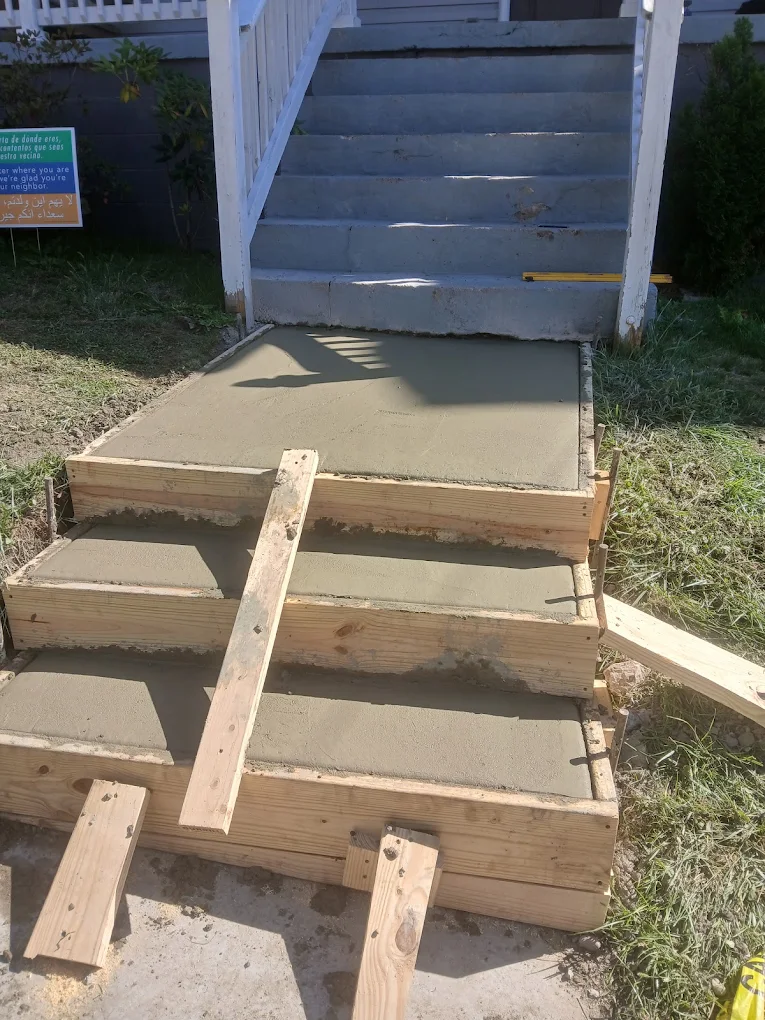
Fixing the Drainage That Sends Ice Onto Your Concrete Stairs
No sealer can keep up with concrete stairs that receive a steady supply of water from somewhere above them. Gutters and downspouts cause more winter stair damage in this region than any other single factor, and the failure mode is simple. A clogged gutter overflows at the low point, which is frequently right above the front entry, and that overflow lands on the top step and runs down the whole flight. During a freeze, that water becomes a smooth glaze of ice that no amount of shoveling removes. Clearing gutters in late fall after the leaves come down, checking that every downspout is connected, and extending discharge points at least four feet away from the stair footprint solves most of these problems for the cost of an afternoon.
The surfaces feeding into the stairs matter just as much as the roof. A porch, landing, or walkway that has settled toward the steps will deliver every drop of rain and snowmelt straight onto the top tread. Proper exterior flatwork should slope away from the structure at roughly a quarter inch per foot, and settled sections can be corrected by slabjacking or by replacing the affected area. The ground alongside the stairs should slope away as well, since saturated soil against the sides of a stair mass feeds moisture into the concrete from directions you never see. Mulch beds and landscape edging that trap water next to the stairs make the situation worse and should be graded so runoff has somewhere to go.
Below grade drainage completes the picture on stairs that lead down to a basement entrance or sit against a retaining wall. Areaway drains at the bottom of a stairwell clog with leaves and silt constantly, and a blocked drain turns the entire stairwell into a basin that freezes solid. Those drains need to be cleared every fall and checked again after heavy leaf drop. Retaining walls next to stairs should have functioning weep holes and a gravel backfill so hydrostatic pressure does not push water sideways into the stair structure. Water that gets behind or beneath concrete stairs and freezes there can lift and shift the entire assembly, which is a far more expensive problem than surface scaling. Correcting these systems before the ground freezes is the difference between a routine winter and an emergency call in January.
Repairing Cracks and Spalls in Concrete Stairs Before the Ice Arrives
Any opening in a concrete stair is a direct route for water, and fall is the window to close those routes. Hairline cracks under about an eighth of an inch can usually be treated with a penetrating crack sealer or a polymer modified slurry that fills the void and bonds to the surrounding concrete. Wider cracks need to be cleaned out, sometimes routed to create a consistent profile, and filled with a flexible polyurethane sealant that can move as the concrete expands and contracts. Rigid patching material in a moving crack simply fails again the following spring, so matching the repair to the crack behavior is important. All debris, loose material, and old sealant have to come out first, because a patch bonded to dust is a patch that pops out.
Spalled edges and broken noses require a different approach than cracks. The damaged concrete has to be removed back to sound material, which usually means chipping out a defined area with square edges rather than feathering a thin layer over a rough spot. Feathered edges on a stair nose are the most common repair failure in the trade; they are too thin to hold, they debond quickly, and they break off in the first hard freeze. A proper repair uses a bonding agent and a polymer modified repair mortar built up in controlled lifts, often with a form to hold the nose profile while it sets. The finished repair needs to cure properly, which in cool weather can mean covering it with insulating blankets to hold in heat.
Joints deserve attention alongside cracks and spalls. The place where stairs meet the house foundation, the porch, or the sidewalk is an expansion joint, and the material inside it degrades over time from sun and weather. Old joint filler shrinks, cracks, and pulls away from one side, which leaves a slot that collects water and directs it straight down into the base. Cleaning out the old material and installing new backer rod with a quality exterior sealant is a straightforward job with a large payoff. Doing this work in fall gives the sealant time to cure at a comfortable temperature and to be fully set before the first freezing rain. Need cracks or a broken stair nose taken care of? Click here for our concrete stairs service and we will get an estimate scheduled.
Why You Need a Winter Plan for Your Concrete Stairs
Protecting concrete stairs from ice is not a single product or a single afternoon; it is a plan that covers the whole season. That plan includes the fall work described above, a safe method for clearing snow and ice through the winter, and an honest assessment of what your stairs can handle. Stairs carry more liability than any other part of a residential property, and an icy step outside a front door is where most winter falls happen. A homeowner who knows how to clear the steps without damaging them, and who knows when the concrete has reached the end of its service life, avoids both the injury risk and the repeated repair bills. The right plan also costs less than most people expect, especially compared to a rebuild forced by three winters of neglect.
Safe Snow and Ice Removal Methods for Concrete Stairs
The best ice protection for concrete stairs is removing snow before it ever becomes ice. Snow that gets walked on compacts into a dense layer that bonds to the concrete, melts under foot pressure, and refreezes into a glaze that requires chipping to remove. Clearing the steps early in a storm and again after it ends prevents that bond from forming in the first place. Use a plastic shovel rather than a metal one, and keep the blade flat against the tread so the edge does not gouge the surface or catch the nose. Chipping ice off concrete with a steel spade or an ice chisel removes concrete along with the ice, so it should be a last resort.
For traction, sand and similar abrasives do the job with no chemical risk to the concrete at all. Spread a light layer across each tread once the snow is cleared, and sweep the residue off in spring so it does not wash into the drains. If a melting product is truly necessary, calcium magnesium acetate is the gentlest option commonly available, though it works slowly and loses effectiveness in very cold weather. Use any deicer sparingly, apply it only where you need footing, and rinse the stairs during a thaw to move accumulated chlorides off the surface. Never use a deicer on stairs poured within the last twelve months.
Physical solutions handle the problem without any product at all. Rubber or composite stair treads with a textured surface give reliable footing all winter and protect the concrete underneath from both abrasion and salt exposure. Heated mats designed for stairs, or embedded snow melting systems installed during a new pour, keep steps clear automatically and are worth considering for households with mobility concerns. A solid handrail is the most underrated piece of winter stair safety and is required by code on most flights of four or more risers. If snow management on the property as a whole is the bigger headache, click here for our snowplowing service and we will keep the approach clear too.
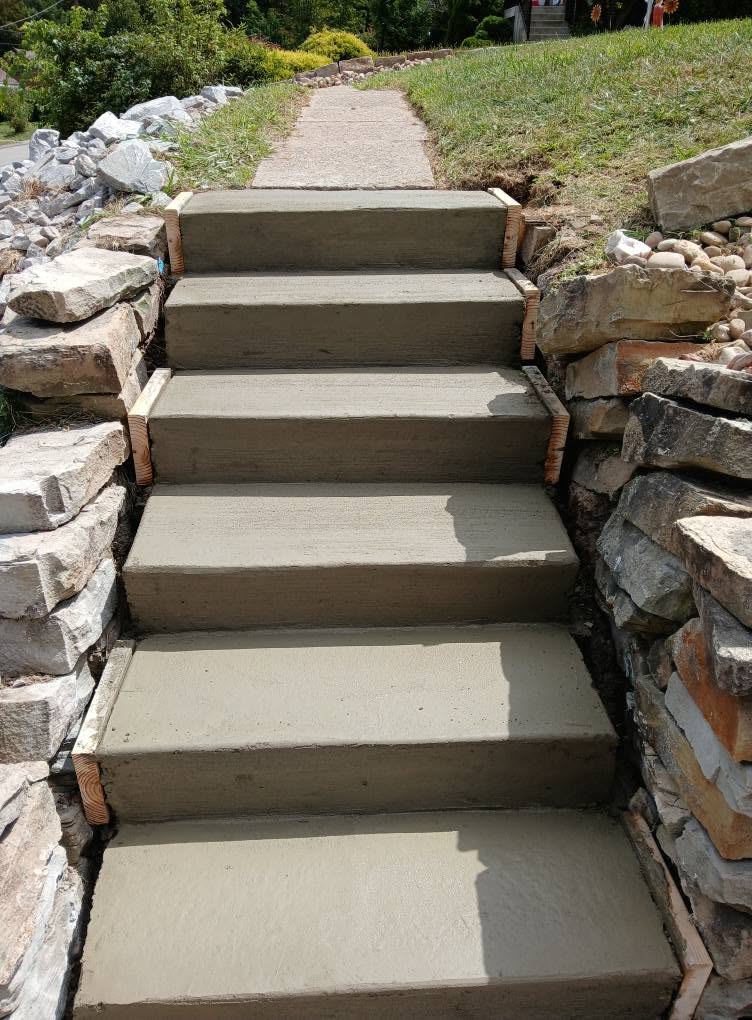
When Concrete Stairs Need Replacement Instead of Ice Protection
There comes a point where protecting concrete stairs from ice is no longer the right conversation, and recognizing it saves money. Surface scaling that has progressed to exposed aggregate across most of the treads means the wearing surface is gone, and sealer applied at that stage will not restore strength. Spalling that has exposed reinforcing steel is a structural issue, because corroding rebar keeps expanding and will continue to break the concrete apart regardless of what goes on top. Steps that have separated from the structure, that tilt noticeably, or that move under weight have a base problem that no surface repair addresses. Multiple full width cracks with height differences between the sides fall into the same category.
Replacement also becomes the better value when the cost of repeated repairs starts approaching the cost of a new pour. Patching a stair nose every spring for five years costs more in total than rebuilding the flight once and sealing it correctly. New stairs also give you the chance to correct the problems that caused the damage, including base preparation, drainage, riser height consistency, and tread slope. A properly built flight should have a slight slope on each tread to shed water, a compacted stone base below the frost line where required, and air entrained concrete specified for freezing and thawing exposure with deicers. Those details are what separate stairs that last thirty years from stairs that fail in eight.
Timing a replacement takes some planning in this climate. Concrete can be placed in cold weather with the right precautions, including heated mixing water, accelerating admixtures, insulated blankets, and temporary enclosures, but the work costs more and the window is tighter. Placing new stairs in fall or spring gives the concrete moderate curing conditions and gives you time to seal before the weather turns. If your stairs are borderline heading into winter, a professional assessment now tells you if they will make it through another season safely. That answer is worth having before someone slips on a step that was already failing.
Why Choose RMK Concrete Services for Your Concrete Stairs
RMK Concrete Services is a family owned and operated company working out of 512 Carolyn Ave in Pittsburgh, and we build and repair concrete stairs across the city and a sixty mile radius around it. We are licensed and insured, and we treat every set of steps as a safety item first and a curb appeal item second. Our crews know what Pittsburgh winters do to exterior concrete because we repair the results every spring, so we build and seal with those conditions in mind from the start. We offer free in person estimates on all projects, which means someone actually looks at your stairs, your drainage, and your base conditions before quoting a number. Integrity is at the core of how we operate, and we will tell you plainly when a repair makes sense and when it does not.
We handle the full range of work these steps need, from sealing and crack repair to full replacement with proper base preparation and drainage correction. We also offer discounts for veterans and seniors, because the people who most need safe stairs in winter should not be priced out of getting them. Our goal on every job is a five star result, and we hold ourselves to that on a two step porch the same way we would on a large commercial project. Scheduling in fall gives us the temperatures we need to do the work correctly and gives you the whole winter of benefit from it. Call us at (412) 902-5114 or email info@rmkconcrete.com to get on the calendar.
Winter in this region is not gentle, and the ice does not care how nice your steps looked in July. Sealing the concrete, correcting the water that reaches it, and repairing the damage that already exists are three straightforward jobs that pay for themselves in avoided repairs and avoided falls. Do them before the first hard freeze and your stairs will come through the season in the shape they went into it. Wait until January and the options narrow to sand, patience, and a repair bill in spring. RMK Concrete Services is ready to handle it now, while there is still time to do it right.