
Pittsburgh winters put more stress on concrete than almost any other season, and most of the damage homeowners see in spring starts with how snow was cleared in January and February. A driveway that looked perfect in October can show flaking, pitting, and cracked edges by April simply because the wrong shovel, the wrong deicer, or the wrong plow setup was used week after week. The good news is that concrete damage from snow removal is almost entirely preventable once you understand what actually causes it. Salt is only part of the story; water, temperature swings, and metal blades do a great deal of the harm. Early fall is the right time to think about this, because the products you buy and the tools you set aside now are the ones you will grab the first morning the driveway is covered. Planning ahead also gives you time to seal, repair, or replace surfaces before freezing weather makes that work impossible. This guide walks through what damages concrete during snow removal, what protects it, and how to set your property up so the surface you paid for still looks right in five years.
What Causes Concrete Damage During Snow Removal
Concrete is strong under compression and much weaker under the internal pressure created by water freezing inside it, which is the root of nearly every winter surface problem. When snow melts during the day and refreezes overnight, that moisture works its way into the pores of the slab and expands roughly nine percent as it turns to ice. Repeat that cycle dozens of times across a Western Pennsylvania winter and the surface paste begins to loosen, flake, and separate from the aggregate underneath. Deicing chemicals accelerate the process because they force melting and refreezing to happen more often, and some of them react chemically with the cement paste itself. Add a steel shovel edge or a plow blade riding directly on the slab and you have mechanical damage layered on top of chemical and thermal damage. Understanding these three forces makes it much easier to choose tools and products that keep your concrete intact.
Freeze Thaw Cycles and Snow Removal Damage on Concrete
Freeze thaw damage is the leading cause of concrete surface failure in the Pittsburgh region, and it happens quietly across an entire season rather than in one dramatic event. Our winters are notorious for hovering right around thirty two degrees, which means a driveway can freeze and thaw several times in a single week instead of staying frozen the way it might in northern Minnesota. Each cycle drives water deeper into the capillary pores of the slab, and each time that water expands it puts tensile pressure on paste that was never designed to resist much tension. Properly placed exterior concrete contains microscopic air bubbles introduced during mixing, and those bubbles give the expanding water somewhere to go, which is why air entrainment is required for outdoor flatwork in cold climates. Concrete that was poured without adequate air entrainment, finished while bleed water was still on the surface, or troweled too aggressively will fail much faster no matter how carefully you shovel. Snow removal matters here because leaving packed snow and ice on a slab keeps it saturated for days at a time, and a saturated slab is far more vulnerable to freezing damage than a dry one.
The practical takeaway is that clearing snow promptly is itself a form of concrete protection, not just a convenience or a safety measure. A driveway cleared down to bare concrete in the morning has a chance to drain and dry during daylight hours, which lowers the moisture content in the top layer before the temperature drops again. Snow left in place melts slowly from the bottom, feeds water continuously into the surface, and refreezes as a solid sheet that traps even more moisture underneath. Drainage plays a major role as well, since low spots and areas where downspouts discharge onto the slab will always show damage first. If you notice one section of your driveway or sidewalk deteriorating faster than the rest, look upslope for the water source rather than blaming the concrete itself. Correcting grading and downspout discharge before winter often does more for a slab than any product you can buy at a hardware store.
Age matters enormously in this equation, and new concrete deserves special handling during its first winter. Concrete reaches most of its design strength within twenty eight days, but it continues to cure and dry for months, and a slab poured in late summer or fall still holds considerable internal moisture heading into December. Industry guidance from the American Concrete Institute is clear that deicing chemicals should not be applied to concrete during its first winter of service. Sand for traction is the correct choice on a young slab, and it costs almost nothing compared to repairing scaled concrete two years later. If your driveway, patio, or sidewalk was poured this year, treat that first season as a protection period and plan on sealing once the surface has fully cured. Homeowners who follow that rule routinely get decades out of a slab, while those who salt a fresh pour often see visible surface loss by the following spring.
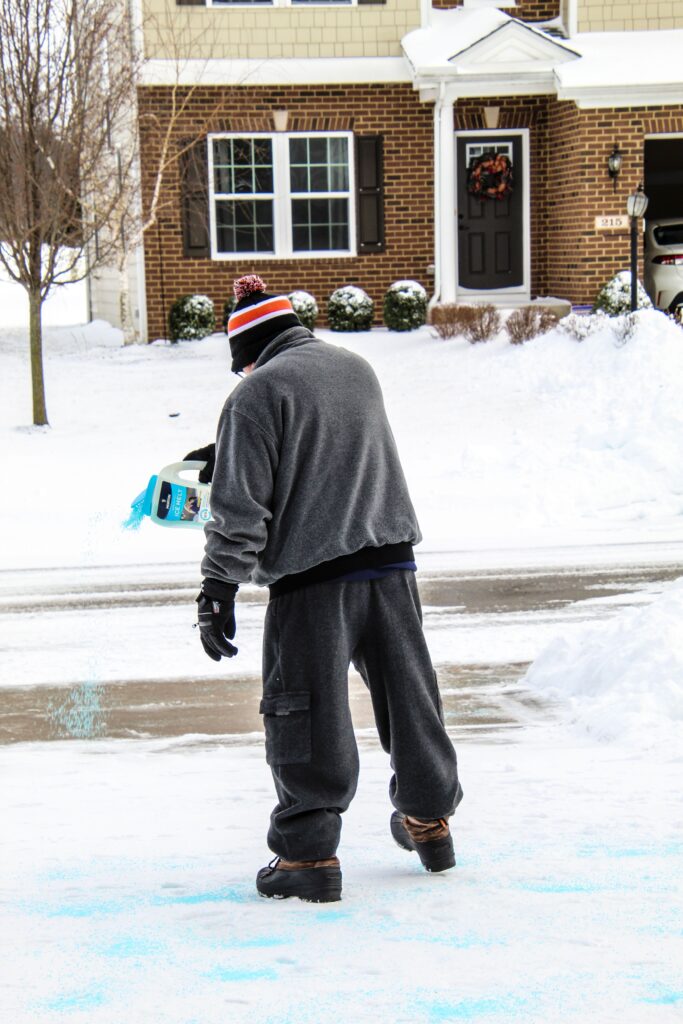
Deicing Salt Damage That Snow Removal Leaves on Concrete
Rock salt, which is sodium chloride, does not attack cement paste chemically in the way many people assume, but it still causes serious damage through the mechanism of increased freeze thaw activity. Salt lowers the freezing point of water, which means a slab that would have stayed frozen and stable instead melts, absorbs brine, and refreezes when temperatures drop further. Brine also holds more water in the concrete than plain melt would, raising saturation levels in exactly the top layer that suffers first. On top of that, chloride ions migrate through concrete and reach embedded steel reinforcement, where they break down the protective environment around the metal and allow corrosion to begin. Corroding rebar expands and pushes the concrete apart from the inside, producing cracks that run parallel to the reinforcement and eventually spall large sections loose. That process takes years, which is why chloride damage often shows up long after the homeowner has forgotten how much salt was spread each winter.
Some deicers commonly sold as safer or faster are actually harder on concrete than plain rock salt, and label marketing rarely explains this. Magnesium chloride reacts with the calcium silicate hydrate that gives cement paste its strength, converting it into a weaker magnesium compound and softening the surface over time. Calcium chloride can react with the hydrated cement to form calcium oxychloride, an expansive compound that generates internal pressure even at temperatures where no ice is present. Both products melt snow effectively at low temperatures, which is why municipalities and airports use them, but both carry real risk on residential flatwork. The most damaging products of all are fertilizers containing ammonium sulfate or ammonium nitrate, which are occasionally recommended as a homemade deicer and which chemically dissolve concrete with remarkable speed. Anything sold as a lawn fertilizer should never be spread on a driveway or sidewalk under any circumstances.
Salt damage also travels, which is why concrete inside a garage often deteriorates even though it never sees a snowstorm. Vehicles pick up brine from treated roads, carry it home, and drip it onto the garage floor for hours as the undercarriage warms and the slush melts. Those puddles concentrate as the water evaporates, leaving increasingly aggressive salt residue exactly where it can soak into an unsealed floor. The same effect shows up on the apron where the driveway meets the street and along the edges where plowed street salt piles up. Rinsing the garage floor during warm spells and keeping it sealed makes a substantial difference in how it looks a decade from now. If your garage floor is already showing pitting or a chalky white surface, our garage floor services can restore and protect it before the damage reaches the reinforcement.
Shovel and Plow Damage During Snow Removal on Concrete
Mechanical damage from snow removal equipment is the most visible and most avoidable form of concrete harm, and it usually shows up along control joints, edges, and any high spot in the finish. A steel shovel blade dragged across a slab will catch on the raised lip of a joint or a trowel mark and chip the paste right off, exposing aggregate that then absorbs water freely. Those chips look minor in the moment, but each one becomes a new entry point for moisture and a new starting place for freeze thaw deterioration. Metal edged shovels are particularly hard on decorative surfaces such as stamped concrete or exposed aggregate, where the profile of the finish guarantees the blade will strike raised areas. Plastic shovels with a hard polymer edge clear snow nearly as well on a flat slab and cause a fraction of the damage. Replacing a worn shovel every couple of seasons costs less than repairing a single spalled corner.
Snow blowers and plows introduce a different set of risks because they carry far more force than a person pushing a shovel. A single stage snow blower with a rubber paddle designed to contact the ground works well on smooth concrete, but the paddles wear down and eventually expose the metal backing plate underneath, which will gouge a slab quickly. Two stage machines ride on skid shoes and should be adjusted so the auger housing stays roughly a quarter inch above the surface rather than scraping it. Plow trucks and skid steers cause the most damage when the operator runs a steel cutting edge with no shoes, no rubber edge, and no awareness of where joints and edges sit. Professional operators use polyurethane or rubber cutting edges on residential work for exactly this reason, and they angle the blade to lift snow rather than scrape the surface bare. Marking the edges of a driveway with stakes before the first snowfall also prevents the single most expensive plow mistake, which is dropping a corner of the blade off the slab edge and cracking it.
Where snow gets piled matters more than most homeowners expect, and poor pile placement causes damage that appears months later. Piles stacked on a lawn next to a driveway melt slowly and send brine laden water back across the slab repeatedly through late winter. Piles placed on top of the concrete itself keep that section saturated for weeks and often leave a distinctly deteriorated patch once spring arrives. Snow banked against a garage door, a foundation wall, or a set of concrete stairs pushes moisture toward areas that were never designed for continuous contact with standing water. The right approach is to push snow downhill and away from structures, toward areas with good drainage that will not send meltwater back over finished surfaces. If your stairs or walkways already show cracking from winters past, our concrete repair services can address the damage before another freeze season makes it worse.
Safe Snow Removal Tips That Protect Your Concrete
Protecting concrete through a Pittsburgh winter comes down to a short list of habits that cost very little and take almost no extra time. Choose tools that will not gouge the surface, choose traction and melting products with an eye toward chemistry rather than marketing, and clear snow before it has a chance to pack down and refreeze. Sealing the slab ahead of the season adds a barrier that keeps water and chloride out of the pores where they do their damage. Managing drainage so meltwater leaves the property instead of pooling on flatwork handles the problem at its source. None of this requires special equipment or expensive products; it requires deciding on a plan before the first storm rather than improvising during it. The tips below cover the tools, the products, and the timing that make the difference.
Snow Removal Tools That Protect Your Concrete
Start with the shovel, because it is the tool you will use most and the one most likely to cause everyday damage. A poly blade shovel with a reinforced polymer wear strip clears snow effectively and will not chip a joint lip or a trowel ridge the way a steel edge does. Choose a blade width you can actually push when the snow is heavy and wet, since an oversized shovel encourages the kind of hard scraping that damages surfaces. Ergonomic handles reduce back strain and, more relevant here, reduce the temptation to dig at packed snow with the blade corner. Keep a second shovel dedicated to stairs and decorative areas so you are never tempted to use a heavy tool on a delicate finish. Inspect the wear strip each fall and replace the shovel once the edge has worn thin or developed nicks that will catch on the concrete.
Snow blowers deserve an annual setup check before the first storm rather than a rushed adjustment in the driveway at six in the morning. On a single stage machine, look at the rubber paddles and replace them if the wear indicators have disappeared or if you can see metal at the paddle tips. On a two stage machine, set the skid shoes so the housing clears the concrete slightly, and use the wider shoes designed for paved surfaces instead of the narrow ones meant for gravel. Check that the shear pins are the correct type, since substituting hardware store bolts can cause the auger to keep driving after it strikes an obstruction. Run the machine at a speed that lets it throw snow rather than push it, because forcing the pace pushes the housing down into the slab. A machine set up correctly leaves a thin layer of snow behind, and that thin layer is exactly what you want, because it means the auger is not riding on your concrete.
For anyone hiring out the work or running their own plow, cutting edge choice separates careful contractors from careless ones. Polyurethane and rubber cutting edges flex over joints and imperfections instead of catching on them, and they leave decorative concrete intact where steel would strip it. Plow shoes hold the blade slightly off the surface and dramatically reduce gouging on both concrete and asphalt. Angling the blade rather than pushing straight into a pile reduces the downward force that drives an edge into the slab. Operators should also know where every edge, drain, and grade change sits, which is why staking a driveway before the season is standard practice on well run accounts. Want reliable clearing that treats your surfaces with care? Click here for our snowplowing services throughout Pittsburgh and the surrounding communities.

Safer Deicer Choices for Snow Removal on Concrete
The safest traction product for concrete is not a deicer at all; it is clean sand or a similar abrasive that provides grip without introducing any chemistry to the slab. Sand does nothing to melt ice, so it works best on surfaces where you plan to clear mechanically and simply need traction in the meantime. It does need to be swept up in spring to keep it out of drains and off lawns, which is a small tradeoff for zero chemical exposure. On new concrete in its first winter, sand should be the only product you use, without exception. Kitty litter is often suggested as a substitute but many varieties turn to slick clay paste when wet, so a bagged traction sand is the better buy. Keeping a bucket of sand near the door makes it easy to treat a walkway before anyone slips.
When melting is genuinely necessary, calcium magnesium acetate is the product with the best track record around concrete because it does not introduce chlorides and does not react destructively with cement paste. It works more slowly than chloride based products and loses effectiveness below the middle twenties, so it fits mild storms and maintenance applications better than ice emergencies. Plain rock salt remains a reasonable choice on mature, sealed concrete when used sparingly, since it lacks the aggressive chemical reactions of magnesium and calcium chloride. The critical variable with any product is quantity, because homeowners routinely apply five to ten times what is needed. A light, even scatter that leaves visible gaps between granules melts just as effectively as a heavy coating and leaves far less residue behind. Spread the product, give it time to work, then clear the loosened slush mechanically instead of waiting for chemistry to do the whole job.
There are a few products that should never touch your concrete regardless of what the label promises or what a neighbor recommends. Ammonium sulfate and ammonium nitrate fertilizers dissolve cement paste directly and can ruin a surface in a single season. Deicers marketed as pet safe are usually urea based, which is gentler on paws but still adds nitrogen compounds and performs poorly at low temperatures. Blended products often list chlorides as the primary ingredient with a small percentage of something friendlier added for marketing purposes, so read the actual ingredient list rather than the front of the bag. Store whatever you buy in a sealed container off the concrete floor of the garage, since a leaking bag sitting on a slab all winter will etch a permanent mark. A sealed surface tolerates all of these products far better than a bare one, which is why sealing is the single best investment you can make before winter.
Snow Removal Timing and Technique That Protects Concrete
Timing does more for concrete protection than any product on the shelf, and the principle is simple: clear early and clear completely. Snow that is removed while it is still light and fluffy comes off with minimal blade contact, while snow left to pack under foot and tire traffic bonds to the surface and requires scraping to remove. During longer storms, clearing in stages every few inches keeps the job easy and prevents the compacted base layer that turns into ice. That approach also keeps the slab drier, which directly reduces freeze thaw stress during the overnight refreeze. Homeowners who wait for a storm to end often face twice the work and cause several times the surface damage. Setting an expectation of clearing during the storm rather than after it changes the whole equation.
Technique on the slab matters as much as timing, particularly around joints and edges. Push snow along the direction of the control joints rather than across them so the blade glides instead of catching on every lip. Work from the center of a driveway toward the edges to avoid running a blade off the side, which is how corners break. Lift and carry heavy piles rather than dragging them across the surface repeatedly, since dragging both wears the concrete and wears you out. Clear stairs from the top down and use a narrow tool that fits the tread so you are not prying at the nosing, which is the most vulnerable part of any concrete step. Pay particular attention to the transition where a driveway meets the street, since that section takes municipal plow salt, vehicle traffic, and the deepest drifts all at once.
Where you put the snow closes the loop on the whole process. Send piles downhill and toward drainage, keeping them off the concrete and away from foundation walls, garage doors, and steps. Avoid piling snow over storm drains or in a way that blocks meltwater from leaving the property, since standing water refreezing on flatwork undoes all the careful work. Watch for icicles and roof runoff dripping onto walkways, because that concentrated water source creates ice patches and localized surface damage in the same spot every year. In late winter, break up remaining ice piles on warm days so they drain rather than sitting on the slab into March. Small adjustments in where snow ends up account for a surprising share of the difference between a driveway that ages well and one that does not.
Why You Need Professional Help With Snow Removal and Concrete Protection
Careful snow removal protects concrete, but it cannot fix a slab that was poured poorly, never sealed, or already carrying cracks and spalled areas. Fall is the window when sealing, repair, and replacement work can still be completed before freezing temperatures shut down concrete work for the season. It is also the right time to line up reliable snow clearing so you are not calling around during the first storm along with everyone else. RMK Concrete Services handles both sides of this equation, which means the same company that pours and maintains your concrete also knows how to clear it without damaging it. We serve Pittsburgh and a sixty mile radius, and we offer free in person estimates on every project. A short conversation now can save a considerable repair bill in April.
Why Professional Snow Removal Protects Your Concrete Investment
Professional snow clearing is not just about convenience; it is about having equipment set up correctly and operators who know what is underneath the snow. Our crews use appropriate cutting edges and blade settings for residential concrete rather than treating every driveway like a parking lot. We mark edges and note grade changes ahead of the season so nothing gets caught, dropped, or dug into during a storm. Snow gets placed where it will drain away from your structures and off your finished surfaces instead of piled wherever is closest. Consistent clearing throughout a storm keeps the slab drier and reduces the freeze thaw stress that causes surface scaling. Need dependable winter clearing this season? Click here for our snowplowing services and get on the schedule before the first storm.
There is also a liability side that homeowners and property owners should weigh carefully. Ice on a walkway or an entry creates real risk for family, guests, tenants, and customers, and inconsistent clearing tends to produce exactly the refrozen patches that cause falls. Professional service applies traction products in appropriate amounts at appropriate times, which protects people without dumping unnecessary chloride on your concrete. Commercial properties often carry contractual clearing obligations, and documentation of service matters if a claim ever arises. Reliable clearing also keeps access open for deliveries, employees, and emergency services throughout the season. Handing the work off means it happens on schedule regardless of travel, illness, or a storm that starts at four in the morning.
For older adults and anyone with health considerations, the physical demands of snow removal are a genuine concern rather than an abstraction. Shoveling heavy wet snow is strenuous work performed in cold air, and emergency rooms across the region see the consequences every winter. Hiring the work out removes that risk entirely while also removing the temptation to take shortcuts that damage the slab. RMK Concrete Services offers discounts for veterans and seniors, which makes regular professional clearing more accessible. Scheduling service in advance also means you are covered for the storms that arrive without much warning. The result is a safer property, a healthier winter, and concrete that comes through the season intact.

Concrete Sealing and Repair Before Snow Removal Season
Sealing is the most cost effective step you can take to protect concrete from winter, and fall is the correct time to do it. A penetrating sealer based on silane or siloxane chemistry soaks into the surface and creates a water repellent layer within the concrete rather than a film on top of it. That layer reduces water absorption dramatically, which cuts freeze thaw stress and slows the migration of chloride ions toward reinforcement. Penetrating sealers do not change the appearance of the slab or create a slippery surface, and they typically last several years before reapplication. Application requires dry concrete and temperatures above freezing, which is why the window closes as winter approaches. Want to protect your slab before winter arrives? Click here for our concrete sealing services and schedule a free estimate.
Existing damage should be addressed before the season rather than after, because every crack and spalled area gets worse once water gets into it and freezes. Cracks admit water directly into the slab and the base beneath it, where freezing causes movement, settlement, and further cracking. Spalled and scaled areas expose aggregate and increase the surface area available for water absorption. Joint sealant that has failed or pulled away lets water into the one place a slab was specifically designed to keep it out. Our team evaluates whether repair, resurfacing, or replacement makes the most sense for your situation and gives you a straight answer rather than an upsell. Catching problems in fall usually means a smaller, cheaper fix than waiting until the damage has spread through another winter.
Some slabs reach a point where repair stops being the economical choice, and knowing that honestly saves money in the long run. Concrete with widespread scaling, a failing base, or damage from corroding reinforcement will keep deteriorating no matter how much surface work is done. A properly placed replacement slab with correct air entrainment, adequate thickness, proper jointing, and a solid compacted base will handle Pittsburgh winters for decades. Fall replacement is very achievable as long as the work is scheduled before sustained freezing weather arrives. Ready to discuss a new driveway or repairs to your existing one? Click here for our driveway paving services and request a free in person estimate.
Why Choose RMK Concrete Services for Snow Removal and Concrete Care
RMK Concrete Services is family owned and operated, and integrity sits at the core of how we run every job from a small sidewalk repair to a full driveway replacement. We are licensed and insured, and we provide free in person estimates on all projects because a real assessment requires standing on the concrete rather than guessing over the phone. Our crews work throughout Pittsburgh and a sixty mile radius, covering communities from Mount Lebanon and Bethel Park to Monroeville, Cranberry Township, and beyond. We offer discounts for veterans and seniors as a matter of practice, not as a limited promotion. Every project is handled with the goal of earning a five star review through work that holds up rather than work that looks good on day one.
What sets us apart on winter work is that we understand concrete as builders, not just as a surface to scrape. We know where control joints sit, how a slab drains, which finishes are vulnerable, and what a plow blade does to a stamped patio when it is set wrong. That knowledge shapes how we clear snow and how we advise clients on products and timing. It also means we can spot early signs of surface trouble during a routine clearing visit and let you know before a small issue becomes a large one. Clients appreciate having one company that handles the pouring, the sealing, the repairs, and the winter clearing.
Getting started is straightforward, and there is no cost or obligation to find out what your property needs. Call us at (412) 902-5114 or send a message to info@rmkconcrete.com, and we will schedule a visit at a time that works for you. We will walk the property, look at drainage and existing conditions, and give you an honest recommendation along with clear pricing. If sealing makes sense, we will tell you; if the slab needs replacement, we will explain why. Reach out this fall and go into winter with concrete that is protected and clearing that is already on the schedule.