
Every winter, homeowners across Pittsburgh reach for the same blue bag of rock salt, and every spring those same homeowners notice their sidewalk looking flaky, pitted, and rough underfoot. Rock salt, which is simply sodium chloride in a coarse crystal form, does an excellent job of melting ice at moderate temperatures, but it puts your concrete through a punishing cycle that the mix was never designed to survive year after year. The damage is rarely dramatic in the first season, so most people assume the surface is fine and keep spreading the same product from the same bag. By the third or fourth winter, the top layer of mortar starts to release, aggregate shows through, and the sidewalk that once looked smooth begins to look like a gravel path. Understanding exactly how salt works on concrete makes the problem much easier to prevent, and prevention costs a small fraction of a replacement. This guide walks through the science behind the damage, the warning signs worth checking this fall, and the steps that keep your sidewalk intact through a Pittsburgh winter.
How Rock Salt Damages Your Sidewalk Concrete
Concrete looks solid, yet it is a porous material with a network of tiny capillaries running through the paste that binds the sand and stone together. Water moves into those capillaries whenever the surface is wet, and rock salt changes how that water behaves once temperatures drop. The salt itself does not eat the concrete in a chemical sense the way some marketing claims suggest, since sodium chloride is fairly mild compared to magnesium chloride or calcium chloride. The real harm comes from physical stress, moisture loading, and corrosion of the steel buried inside the slab. Once you see those three forces working together, the flaking surface on your sidewalk stops looking like bad luck and starts looking like a predictable result.
The Freeze Thaw Cycle Behind Rock Salt Sidewalk Damage
Pittsburgh sits in one of the harder freeze thaw climates in the country, with roughly sixty to seventy cycles crossing the freezing point in a typical year. Each cycle asks your sidewalk to absorb water, hold it, freeze it, and then release it without cracking. Water expands by about nine percent when it turns to ice, and that expansion generates real pressure inside the capillary pores of the concrete paste. Air entrained concrete handles this by design, because the microscopic air bubbles mixed into the batch give the freezing water somewhere to expand. When a slab was poured without proper air content, or when the surface was overworked during finishing and the air was driven out of the top layer, that relief valve disappears. The pressure then goes directly into the paste itself, and the paste is the weakest part of the system. Rock salt makes all of this considerably worse by increasing how many times per winter that entire cycle actually happens.
Salt lowers the freezing point of water, which is exactly why it melts ice in the first place. A brine solution sitting on your sidewalk might stay liquid at twenty five degrees when plain water would already be frozen solid. That sounds helpful, and for traction it certainly is, but it also means the slab spends far more of the winter in a wet state instead of a frozen one. When the temperature drops further overnight, the brine finally freezes, and it freezes inside concrete that is now much wetter than it would have been without any salt at all. A sidewalk that might have gone through fifteen genuine freeze thaw events in a season can easily go through thirty or more once salt enters the picture. Every additional cycle is another round of internal pressure working against the same weakened paste. Multiply that across five or six winters and the surface simply gives up.
There is a second effect that most homeowners never hear about, and it involves how quickly the ice actually melts. Melting requires energy, and the salt pulls that energy out of the concrete surface as heat. The result is a sharp temperature drop in the top quarter inch of the slab, sometimes ten degrees or more in a matter of minutes. Thermal shock like that creates stress between the chilled surface layer and the warmer concrete sitting beneath it. The two layers want to contract at different rates, and the bond between them takes the entire strain. Laboratory scaling tests such as ASTM C672 were developed specifically because this behavior is so consistent and so destructive. Concrete that performs well in a plain freeze thaw test can still fail badly once a salt solution is introduced into the same conditions.
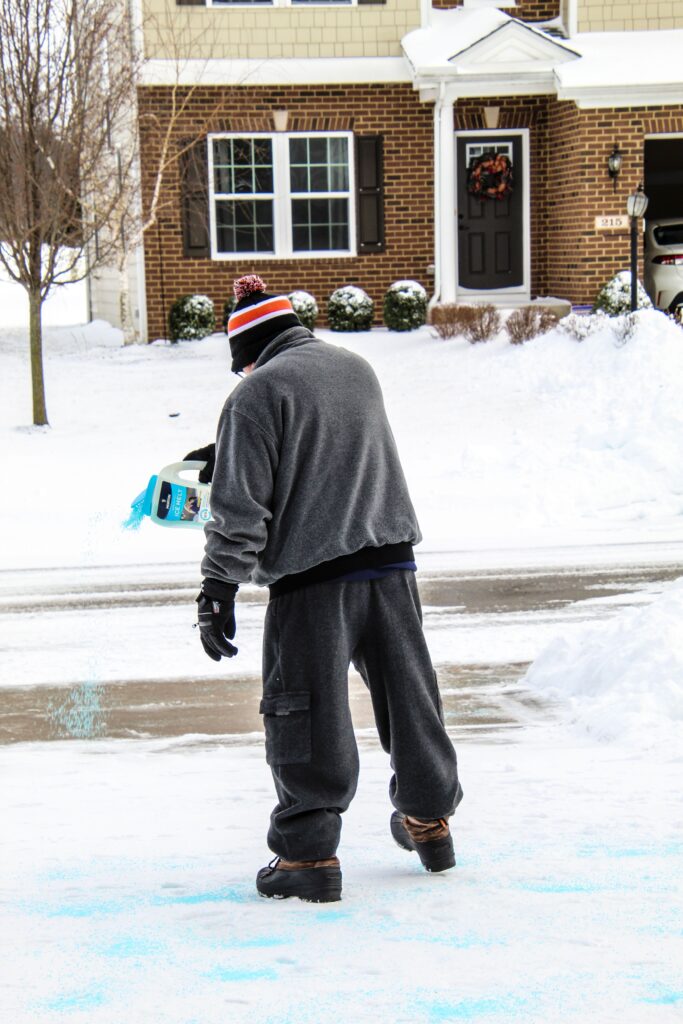
How Rock Salt Pulls Moisture Into Sidewalk Concrete
Sodium chloride is hygroscopic, meaning it attracts and holds water from its surroundings. Once salt works its way into the pore structure of your sidewalk, it does not simply rinse away with the next rain. Crystals stay behind in the capillaries and keep drawing moisture toward themselves through the rest of the season. A salted slab therefore carries a higher degree of saturation than an unsalted one, even during the dry stretches that show up in February. Concrete research has long identified a critical saturation threshold near ninety one percent, above which freezing damage becomes almost unavoidable. Clean concrete rarely reaches that level on its own because it drains and dries between storms. Salted concrete reaches it regularly, and that single fact explains most of the scaling you see on residential walkways around the city.
Salt also creates osmotic pressure inside the slab, which layers another form of internal stress on top of everything else. Different areas of the concrete end up holding different salt concentrations depending on how the brine soaked in and where it pooled. Water naturally migrates from the low concentration zones toward the high concentration zones in an attempt to balance the difference. That migration pushes fluid through pores that were never intended to carry that kind of flow. When freezing begins, the advancing ice front pushes still more unfrozen brine ahead of it into the surrounding pores. Pressure then builds in isolated pockets rather than evenly across the surface, which is why scaling so often shows up in irregular patches instead of a uniform layer. Homeowners frequently describe the pattern as random, though it maps almost perfectly onto where salt collected and where water sat the longest.
Salt crystallization adds a third mechanism that operates even when temperatures stay well above freezing. As a salted sidewalk dries out, the brine trapped inside the pores becomes concentrated enough for solid crystals to form again. Growing crystals exert genuine force against the pore walls, in much the same way that expanding ice does. This process repeats every time the slab wets and dries, which in a Pittsburgh winter can mean dozens of repetitions between November and March. Salt crystallization is the same force that carves deep recesses into sandstone cliffs, only compressed into a far shorter timeline. Your sidewalk is much denser than sandstone, yet the surface paste is thin and the attack never really stops. Over several winters this becomes the difference between a walkway that ages gracefully and one that needs full replacement in year eight.
Rock Salt Sidewalk Damage That Reaches Rebar and Wire Mesh
Most residential sidewalks in the Pittsburgh area contain some form of steel, usually welded wire mesh or light rebar placed near the middle of the slab. Fresh concrete protects that steel through its high alkalinity, which sits around a pH of twelve to thirteen and forms a passive oxide film across the metal. That film is the reason properly built concrete can hold steel for decades without a trace of rust. Chloride ions from rock salt break down the passive film once they reach the steel in sufficient concentration. Chlorides move through concrete slowly, following the same capillary paths that carry water, and any existing crack accelerates that trip considerably. The steel then begins to corrode in the presence of moisture and oxygen, both of which are already abundant in a salted slab. Corrosion inside concrete is never a cosmetic issue, because rust occupies several times the volume of the original steel it replaces.
That volume increase generates tensile pressure from the inside out, and concrete is weak in tension by its very nature. The first visible symptom is usually a fine crack running parallel to the buried bar or wire below. Rust staining often bleeds up through the crack and leaves an orange brown streak across the finished surface. Left alone, the crack widens and a section of the slab delaminates above the corroded steel. Tapping that area with a hammer produces a hollow sound rather than a solid ring, which remains one of the most reliable field tests available. Once delamination begins, patching the surface rarely holds, because the corrosion underneath continues right through the repair. Proper correction means removing concrete back to sound material, cleaning or replacing the steel, and rebuilding with a bonded mix designed for the job.
Concrete cover is the single biggest factor in how long embedded steel survives in a salted environment. Exterior flatwork should carry adequate cover over the reinforcement, and mesh that was left lying on the subgrade during the pour offers almost none at all. This is one of the most common defects we find during sidewalk evaluations across Allegheny County, and it dates back to the original installation rather than anything the homeowner did afterward. Chair supports and careful placement cost very little at the time of the pour, yet they add years of service life in a salt heavy climate. If your sidewalk shows rust streaks or hollow sounding areas today, the reinforcement is already compromised and time is working against you. Need a professional assessment of cracking and surface damage? Click here for our concrete repair service.
Signs of Rock Salt Damage on a Pittsburgh Sidewalk
Rock salt damage follows a recognizable progression, and catching it early is the difference between a maintenance task and a replacement project. Most homeowners notice the final stage first, though the warning signs appeared several winters earlier and were easy to miss. A fall walkthrough takes about ten minutes and gives you a clear picture of where your sidewalk actually stands. Bring a screwdriver or a small hammer, inspect the surface in good daylight, and pay close attention to the areas that receive the most deicer. The sections below cover what to look for and what each symptom actually tells you about the condition of the slab.
Surface Scaling as an Early Sign of Rock Salt Sidewalk Damage
Scaling is the first stage of rock salt damage and the one homeowners most often overlook entirely. It appears as a loss of the smooth surface paste, usually to a depth of one sixteenth to three sixteenths of an inch. The sidewalk feels sandy underfoot, and small flakes collect along the edges every time you sweep. Light scaling exposes the fine sand in the mix, while heavier scaling exposes the larger stone underneath it. Because the change happens gradually, plenty of people assume the walkway was simply finished with a rough texture from the beginning. Comparing a section sheltered under a porch roof to a section out in the open usually settles that question in seconds. The protected area stays smooth while the exposed area turns coarse, and salt is the only variable separating them.
Scaling almost always begins in predictable locations, which makes an early inspection straightforward. Check the low spots where meltwater collects, since standing brine has the longest possible contact time with the surface. Look closely at the two feet nearest the street or the driveway apron, because that zone receives both your salt and the salt thrown by passing plow trucks. Examine the areas beside steps and landings where people tend to spread deicer heavily out of an abundance of caution. Panels near downspouts deserve the same attention, since repeated wetting keeps saturation high all winter long. If the scaling follows these patterns rather than appearing evenly everywhere, salt exposure is clearly the driving cause. Uniform surface loss across an entire walkway usually points instead to a finishing problem in the original pour.
Timing tells you a great deal about how far the damage has already progressed. Scaling that shows up during the first winter after installation almost always traces back to a slab that was salted far too soon. New concrete continues gaining strength for weeks after placement, and it should get through one full winter without any deicer whatsoever. Scaling that appears in year four or five on an older sidewalk reflects accumulated exposure rather than any defect in the work. Either way, the damage does not reverse itself, and each additional season removes a bit more material from the top. Once the surface paste is gone, the concrete underneath absorbs water considerably faster than it ever did before. That acceleration is exactly why a lightly scaled sidewalk can decline sharply over just two or three more winters.

Spalling and Pop Outs From Rock Salt Sidewalk Damage
Spalling is the stage past scaling, and it removes material in chunks rather than thin flakes. Depths of a quarter inch to a full inch are common, and the broken areas leave ragged edges that catch shoe soles. Spalls tend to concentrate along joints, at slab corners, and around any existing crack, because those locations allow water and brine to enter from more than one direction at once. Corners are especially vulnerable since they are exposed on two faces and receive very little support from the surrounding concrete. A spalled area collects standing water, and that water freezes and enlarges the void with every cycle that follows. Sidewalk spalling also becomes a genuine trip hazard, which carries real liability for a property owner in Pennsylvania. Municipalities throughout the Pittsburgh region routinely cite homeowners for walkways that have deteriorated to this point.
Pop outs look quite different and come from a different source, though salt speeds them along considerably. A pop out is a small conical crater, usually a quarter inch to two inches across, with a piece of aggregate visible sitting at the bottom. They form when a porous stone in the mix absorbs water, freezes, and expands hard enough to push the concrete above it away. Chert, shale, and certain soft limestones are the usual culprits in regional aggregate supplies. Salt contributes by keeping the slab wetter for longer and by multiplying the number of freezing events those individual stones experience. Scattered pop outs are cosmetic, and many sidewalks carry a few of them without any meaningful loss of strength. Dense clusters signal a broader aggregate quality problem and often show up alongside scaling in the same panels.
Sorting spalling from pop outs matters because the repair paths diverge sharply from that point forward. Isolated pop outs can be filled with a polymer modified patching material once the cavity has been cleaned and dampened properly. Spalling across a significant portion of a panel usually calls for replacing that panel outright rather than patching it. Patches placed over weak or delaminated concrete fail quickly, and a failed patch ends up costing more than doing the work correctly the first time. A contractor should sound the slab, measure the depth of loss, and evaluate the subgrade before recommending any course of action. Want a sidewalk that is built to handle Pittsburgh winters? Click here for our sidewalk paving service.
Cracks, Joints, and Edges That Reveal Rock Salt Sidewalk Damage
Control joints exist to give concrete a planned place to crack as it shrinks and moves through the seasons. In a salted environment those joints become entry points instead, funneling brine straight into the slab and down into the subgrade. Joint edges start to round over and then break away, widening the opening a little more every season. Debris packs into the gap, holds moisture against the concrete, and prevents the slab from expanding the way it was designed to. Sealant that has hardened, cracked, or pulled loose no longer keeps water out of the joint at all. Inspecting and resealing joints each fall takes very little time and eliminates one of the main pathways for chloride to travel. Homeowners who keep their joints tight typically get several additional years out of the same walkway.
Random cracking tells a different story, and the pattern it forms is worth reading carefully. Hairline cracks that wander across a panel usually relate to early drying shrinkage rather than salt exposure. Cracks that run straight and consistent along a line about two inches below the surface generally follow the reinforcement and point toward corrosion. Cracks that widen at one end and show vertical displacement indicate subgrade movement underneath the slab. Salt participates in both of those last two by carrying moisture down into the base material and by attacking the embedded steel. Saturated subgrade in a freeze thaw climate heaves upward and then settles back down, and the slab has no choice but to follow it. Once adjacent panels sit at different heights, sealing and patching no longer solve anything.
Slab edges deserve a close look during any fall inspection of your walkway. The perimeter of a sidewalk receives runoff from both sides and dries considerably more slowly than the center does. Undermining is common where soil has washed out from beneath the edge, leaving that concrete unsupported. Press a foot near an edge and watch carefully for movement, or listen for a knocking sound as the panel rocks against the base. Grass that dies back in a distinct band along the walkway is a strong indicator of heavy salt runoff. Sodium accumulates in soil, damages root systems, and eventually washes into the storm drains that feed local waterways.
Why You Need a Sidewalk Protection Plan Before Rock Salt Season
Rock salt damage is cumulative and permanent, which puts all of the leverage squarely on prevention. Sealing, smarter deicing choices, and prompt snow removal cost very little compared to tearing out and replacing concrete. The window for that work is open right now, since sealers need mild temperatures and dry conditions to cure the way they should. Repairs also go faster and cost less in fall than they do during an emergency call in the middle of February. A short plan put in place this month will protect your sidewalk through the entire winter ahead.
Sealing Your Sidewalk Before Rock Salt Season Arrives
A quality sealer is the most cost effective defense available against rock salt damage. Penetrating sealers built on silane or siloxane chemistry soak into the concrete and line the pores with a water repellent layer. They do not change the appearance or the traction of the surface, which matters a great deal on a walkway people use in winter. Reducing water absorption also reduces chloride absorption, and that protects both the surface paste and the steel below it. Film forming acrylic sealers add color and gloss, though they wear faster under foot traffic and can become slick when wet. For sidewalks in this climate, a penetrating product is almost always the better choice.
Application conditions decide how well any sealer ultimately performs. The slab must be clean, dry, and free of old coatings, since anything left on the surface blocks penetration. Air and surface temperatures should sit above fifty degrees, with no rain expected for at least twenty four hours afterward. New concrete needs to cure for a minimum of twenty eight days before any sealer goes down on it. Early fall is the ideal window in Pittsburgh, because the weather cooperates and the product has time to set well before the first hard freeze. Waiting until December usually means the job gets pushed to spring, after a full winter of unprotected exposure.
Sealers wear out over time, so treat this as ongoing maintenance rather than a single task. Penetrating sealers typically need reapplication every three to five years on residential walkways, and high traffic areas fall toward the short end of that range. A simple test tells you when the time has arrived, since you only need to sprinkle water on the surface and watch what happens. Beading means the sealer is still doing its job, while immediate darkening means the concrete is drinking that water straight in. Ready to protect your concrete before winter? Click here for our concrete sealing service.

Safer Deicing Choices That Prevent Rock Salt Sidewalk Damage
Mechanical removal beats chemistry every single time, and it costs nothing beyond a bit of effort. Shoveling before foot traffic packs the snow down keeps ice from bonding to the surface at all. Clearing snow promptly also keeps the slab drier, which lowers saturation heading into the next freeze. Sand provides traction without melting anything and does no damage whatsoever to the concrete, though it does need sweeping up in spring. Combining early shoveling with sand handles most residential walkways through a normal Pittsburgh storm without any chemical at all. Keeping downspouts directed away from the walkway removes another major source of winter ice.
When a melting product is truly necessary, the choice matters much more than the quantity you spread. Calcium magnesium acetate is the gentlest common option for concrete, and it remains effective down to roughly twenty degrees. Magnesium chloride and calcium chloride melt at lower temperatures, yet both react chemically with the cement paste and cause serious internal damage despite frequent claims of being safe for concrete. Sodium chloride stops working near fifteen to twenty degrees anyway, so piling on more during a cold snap accomplishes nothing except additional harm. Products containing fertilizer such as urea are weak melters and send unwanted nitrogen into local streams. Read the label, use the smallest effective amount, and sweep up the residue once the ice is gone.
New concrete requires special handling regardless of which product you settle on. A slab poured this year should get through its entire first winter without any deicer touching it at all. Vehicles that have picked up road brine will drip that brine onto a driveway or garage floor, which counts as salt exposure just the same. Parking on the street during that first season or rinsing the underside of the vehicle helps a great deal. Protecting a new pour for one winter costs you nothing and preserves decades of service life.
Why Choose RMK Concrete Services for Rock Salt Sidewalk Damage Repair
RMK Concrete Services is a family owned company operating out of 512 Carolyn Ave in Pittsburgh, and we serve properties within a sixty mile radius of the city. We are licensed and insured, and integrity sits at the core of how we quote work and how we build it. Every project starts with a free in person estimate, because a sidewalk cannot be evaluated accurately from photographs alone. We sound the slab, check the joints, examine the subgrade, and tell you plainly what is repairable and what is finished. Discounts are available for veterans and seniors throughout our entire service area.
Our crews build for the climate we actually work in rather than a generic specification pulled off a shelf. That means proper air entrainment for freeze thaw exposure, appropriate mix strength for exterior flatwork, and reinforcement supported at the correct height inside the slab. Subgrade preparation and drainage receive the same attention, since water sitting under a sidewalk causes as much trouble as water sitting on top of it. Joints are cut at the right time and to the right depth so the slab cracks exactly where we plan for it to crack. Finishing is done without overworking the surface, which preserves the air structure in the top layer where salt does its worst damage.
We work throughout Allegheny County and the surrounding communities, including Bethel Park, Ross Township, Mount Lebanon, Monroeville, Cranberry Township, and Moon Township. Homeowners in these areas face the same salt cycle every winter, and we have repaired thousands of feet of walkway damaged by exactly this process. Our goal is a five star experience from the first phone call through the final cleanup. Call us at (412) 902-5114 or email info@rmkconcrete.com to schedule your free estimate before the first freeze arrives. Fall is the right season to seal, repair, or replace, and the schedule fills quickly once temperatures start dropping.