
Summer storms in Pittsburgh dump heavy rain in short bursts, and all of that water has to go somewhere. When it settles on or around your concrete driveway, it starts a slow process of damage that most homeowners never see until it is too late. Poor drainage is one of the leading causes of driveway cracking, sinking, and surface deterioration in Western Pennsylvania. Water works its way under slabs, washes out the base material, and leaves the concrete unsupported. It also soaks into the surface itself, weakening the concrete from the inside out. A driveway that should last 30 years can fail in less than 10 when drainage problems go unaddressed. The good news is that drainage issues are fixable, and July is the perfect time to spot them. This post explains how water destroys concrete driveways and what you can do to stop it.
How Water Damage Destroys a Concrete Driveway
Concrete is strong under pressure, but it is surprisingly vulnerable to water. A concrete driveway is only as good as the compacted base beneath it, and water is the number one enemy of that base. Rainwater that pools on the surface finds every hairline crack and joint, then seeps below the slab. Once underneath, it erodes the gravel and soil that hold the driveway up. Water that soaks into the concrete itself also causes trouble; it carries dissolved salts, feeds surface scaling, and sets the stage for brutal freeze and thaw damage every winter. Summer is when you can actually watch the problem happen. Walk outside during the next heavy rain and look at where the water goes on your driveway. If it pools, flows toward your garage, or disappears along the slab edges, damage is already underway.
Water Damage Under the Concrete Driveway Slab
The most destructive water damage happens where you cannot see it, underneath the concrete driveway slab. Every properly built driveway sits on several inches of compacted gravel base that distributes the weight of vehicles evenly into the soil. When rainwater drains poorly, it flows under the slab edges and through joints, then slowly washes that base material away. This process is called undermining, and it creates hollow voids beneath the concrete. A slab with a void under it has no support in that spot, so the full weight of your car presses down on unsupported concrete. Concrete has excellent compressive strength but poor tensile strength, which means it snaps when it bends over a gap. That is why driveways with drainage problems develop large structural cracks seemingly out of nowhere. You can sometimes detect voids by tapping the slab with a broom handle and listening for a hollow sound.
Undermining gets worse fast once it starts, because every crack it creates lets in more water. The first crack allows rain to pour directly into the void instead of trickling in from the edges. More water means faster erosion, larger voids, and additional cracking in a cycle that feeds itself. Pittsburgh’s clay heavy soils make this worse; clay holds water against the base for days after a storm instead of letting it percolate away. Saturated clay also loses bearing strength, so even the soil under the gravel gets softer. Homeowners often notice their driveway slabs starting to rock or shift slightly when they drive over them. That movement is a clear sign the base has been compromised. At that stage, sealing the cracks alone will not fix the problem because the support underneath is already gone.
Sunken and settled slabs are the final stage of water damage under a concrete driveway. When the base washes out completely, the slab drops into the void and sits lower than the sections around it. This creates trip hazards, ugly uneven joints, and low spots that collect even more water. Water pooling in a sunken section accelerates damage to the neighboring slabs, so one bad panel spreads trouble across the whole driveway. Settled slabs near the garage are especially dangerous because they can tilt drainage toward your foundation. Fixing settled concrete may involve slab replacement, base restoration, or full section repair depending on severity. Catching undermining early is dramatically cheaper than replacing sunken panels. Noticed cracks or sinking already? Click here for our concrete repair service and get a free in person estimate.
Surface Water Damage on a Concrete Driveway
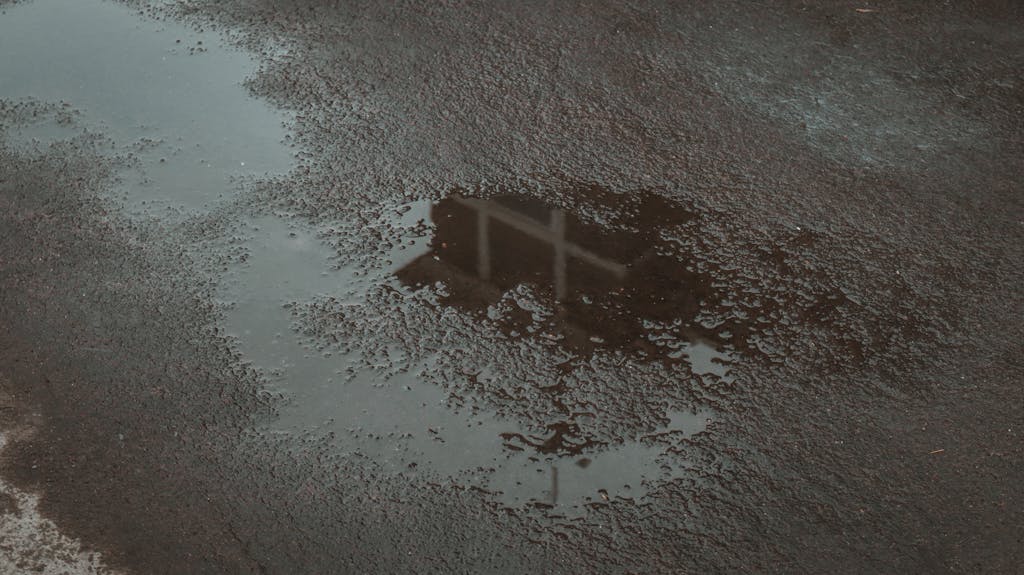
Water does not need to get under the slab to ruin a concrete driveway; it also attacks the surface directly. Concrete is porous, so standing water gradually soaks into the top layer of the slab. Once moisture penetrates, it begins breaking down the cement paste that binds the sand and aggregate together. The first visible symptom is usually scaling, where thin flakes of the finished surface peel away and expose the rougher material beneath. Pitting and spalling follow as small chunks pop out of the surface. A driveway with surface damage looks old, stains easily, and traps dirt and algae in every rough spot. Low areas that pool water after every rain deteriorate fastest, which is why you often see scaling concentrated in one section. Left alone, surface damage deepens year after year until the driveway needs resurfacing or replacement.
Summer in Pittsburgh adds its own stresses to a wet driveway surface. Intense July heat causes the slab to expand, and sudden thunderstorms cool it rapidly, forcing quick contraction. That thermal cycling opens hairline cracks that would stay closed in milder weather. Each new hairline crack becomes another pathway for water to enter the slab. Pooling water also promotes moss and algae growth in shaded areas, and those organisms hold moisture against the concrete around the clock. Oil and automotive fluids mix with standing water and penetrate deeper than they would on a dry surface. Even lawn irrigation contributes when sprinkler overspray hits the driveway daily. The surface never fully dries, and constantly damp concrete deteriorates far faster than concrete that drains and dries between rains.
The moisture your driveway absorbs in summer becomes a wrecking ball in winter. Water trapped in the pores of the concrete freezes when temperatures drop, and freezing water expands about 9 percent in volume. That expansion shatters the cement paste from within, causing widespread scaling, cracking, and spalling by spring. Pittsburgh sees dozens of freeze and thaw cycles every winter, so saturated concrete gets hammered over and over. Deicing salts make it worse by increasing the number of freeze cycles and chemically attacking the surface. This is why fixing drainage in July directly protects your driveway in January. A quality penetrating sealer blocks water absorption and is one of the most cost effective protections available. Want to protect your driveway before winter? Click here for our concrete sealing service.
Drainage Damage at the Concrete Driveway Edges and Joints
The edges and joints of a concrete driveway are its most vulnerable points for drainage damage. Slab edges have less mass than the center and often sit closest to unprotected soil, so erosion attacks them first. When water runs off the driveway and cuts channels along the sides, it removes the soil that laterally supports the slab. Unsupported edges crack and break off under tire loads, especially where vehicles turn onto the driveway from the street. You will often see chipped, crumbling borders on driveways with poor side drainage. Downspouts that discharge next to the driveway are a common culprit, dumping hundreds of gallons along one edge during a single storm. Landscaping that slopes toward the driveway funnels even more water into the same weak spots. Edge damage spreads inward over time, so a crumbling border eventually threatens the entire panel.
Control joints and expansion joints are designed to manage cracking, but they double as water entry points when drainage is poor. Joints are intentionally the thinnest parts of the slab, and water flowing across the driveway naturally collects in them. From there it drips straight down into the base at the exact locations where slabs meet. Erosion at joints causes the classic problem of adjacent panels settling at different heights. Uneven joints create lips that catch snow plow blades, trip pedestrians, and chip under traffic. Old joint filler that has dried out or pulled away leaves the joint wide open to every rainfall. Weeds growing in joints are a telltale sign that soil and moisture have accumulated where they should not be. Resealing joints with quality caulk is inexpensive and blocks a major water pathway.
The transition areas where the driveway meets the garage, sidewalk, street, or apron take constant drainage abuse. These junctions collect runoff from multiple surfaces, and any height mismatch creates a dam that traps water. A driveway that has settled below the garage floor can direct storm water toward the garage slab and even the foundation. The apron at the street endures runoff from the road itself, which carries salt, oil, and grit that grind away at the surface. Gaps at these transitions widen every year as water works through them. Small gaps can be sealed, but large separations signal base failure that needs professional correction. Inspecting these transition points after a summer storm takes five minutes and can save thousands. If you find soft soil, washouts, or standing water at any joint or edge, get it evaluated quickly.
Concrete Driveway Drainage Problems and How to Fix Them
Fixing drainage is about controlling where water goes before, during, and after it touches your driveway. Most drainage problems fall into three categories: bad slope, roof runoff mismanagement, and missing drainage structures. A properly designed concrete driveway sheds water quickly and completely, sending it away from the slab and the house. Many older Pittsburgh driveways were built without much drainage planning, and decades of settling have made things worse. The fixes range from simple weekend maintenance to professional drain installation and regrading. Identifying your specific problem is the first step, and summer’s frequent storms give you plenty of chances to observe. The sections below cover the most common concrete driveway drainage problems and the proven fixes for each.
Fixing Concrete Driveway Slope and Grading Problems
Slope is the foundation of all concrete driveway drainage, and getting it wrong guarantees water problems. A driveway should fall away from the house at a minimum slope of about 2 percent, which equals roughly a quarter inch of drop per foot. That grade moves water off the slab quickly without making the driveway feel steep. Driveways that are too flat let water sit in place, and driveways that slope toward the house send every storm straight at the garage and foundation. Pittsburgh’s hilly terrain complicates things because many driveways run downhill toward the home by necessity. Settling over the years can also reverse a slope that was originally correct. Test your grade by watching runoff during rain or by pouring a bucket of water at the high end. Water that drains fully within a few minutes means your slope is working.
Low spots and birdbaths are the most common grading failures on established driveways. These shallow depressions form where the base settled unevenly or where heavy vehicles compressed one area over time. Every rain refills them, and the standing water soaks into the slab for hours or days. You can map your low spots easily; wait 30 minutes after a storm ends and mark every puddle with chalk. Small shallow depressions can sometimes be corrected with resurfacing or leveling products. Deeper or widespread low spots usually indicate base settlement that surface fixes cannot solve. Slabs that have settled significantly may need replacement with proper base compaction underneath. A driveway with numerous low spots and a failing grade is often a candidate for full replacement done right.
Driveways that slope toward the house present the most urgent grading problem because they threaten the foundation itself. Water directed at the garage slab and foundation wall causes basement seepage, wall cracks, and long term structural stress. Solutions include installing a trench drain at the garage, regrading the approach, or rebuilding the lower section with corrected pitch. Crowning is another technique where the driveway center sits slightly higher so water sheds to both sides. Any regrading or replacement project must start with a properly compacted base, because grade means nothing if the base settles again. This is where professional installation pays for itself over decades. Thinking about a new driveway with correct drainage built in? Click here for our driveway paving service to schedule a free estimate.

Managing Roof Runoff to Protect Your Concrete Driveway
Your roof is the biggest water collector on your property, and it can be your concrete driveway’s worst enemy. A modest 1,500 square foot roof sheds nearly 1,000 gallons of water during a single inch of rain. When downspouts discharge that volume onto or beside the driveway, the concentrated flow erodes edges, floods joints, and saturates the base. Many homes have a downspout positioned right at the driveway corner near the garage, which is exactly the worst spot. Walk around your house during the next storm and trace where every downspout sends its water. Any downspout that dumps within a few feet of the driveway is causing cumulative damage. The stain lines, moss streaks, and washed out soil near these outlets tell the story. Redirecting roof runoff is one of the cheapest and most effective driveway protections available.
Downspout extensions are the simplest fix and cost only a few dollars each. Rigid or flexible extensions should carry water at least 4 to 6 feet away from the driveway and foundation, discharging onto soil that slopes away. Buried drain pipe is a cleaner long term solution; solid PVC carries downspout water underground to a pop up emitter at a safe distance. Splash blocks help in a pinch but often get knocked out of position and overwhelmed in heavy storms. Gutter maintenance matters just as much, because clogged gutters overflow and sheet water down walls and across the driveway in uncontrolled paths. Clean your gutters at least twice a year and after major summer storms. Check that gutter seams are not leaking directly above the driveway. Small runoff corrections now prevent expensive slab repairs later.
Sometimes redirecting downspouts is not enough, and the property needs real drainage infrastructure. A channel drain, also called a trench drain, is a grated channel set into the concrete that intercepts water flowing across the driveway. These are ideal at garage entrances and at the bottom of sloped driveways where water would otherwise pool. French drains handle subsurface water; a gravel filled trench with perforated pipe collects groundwater alongside the driveway and carries it away before it reaches the base. Dry wells give collected water a place to soak into deep soil away from structures. These systems require proper sizing, correct pipe slope, and thoughtful discharge points to work. Installed correctly, they solve drainage problems permanently instead of chasing symptoms. A concrete contractor can integrate drains directly into new or existing driveway slabs.
Sealing and Maintenance to Prevent Concrete Driveway Drainage Damage
Even with good slope and managed runoff, a concrete driveway needs sealing and maintenance to resist the water it does encounter. Concrete sealer is the surface’s first line of defense against moisture absorption. Penetrating sealers soak into the pores and chemically block water while leaving the surface looking natural. Film forming sealers add a protective layer on top and can enhance color on decorative finishes. A sealed driveway sheds water instead of drinking it, which dramatically slows scaling, staining, and freeze thaw destruction. Most driveways should be resealed every 2 to 4 years depending on traffic and exposure. Test yours by sprinkling water on the surface; if it darkens and absorbs instead of beading, the sealer is spent. July’s warm dry stretches provide ideal conditions for sealer application and curing.
Crack and joint sealing is the maintenance task that most directly stops drainage damage. Every open crack is a funnel delivering water to the base, so sealing them promptly protects the support structure under the slab. Hairline cracks can be filled with concrete crack sealant available at any hardware store. Wider cracks need backer rod and a flexible polyurethane caulk that moves with the slab through temperature swings. Expansion joints should be inspected annually and recaulked when the old filler cracks, shrinks, or pulls away. Keep joints clean of soil and weeds, because vegetation holds moisture and pries joints open as roots grow. A tube of quality caulk costs a few dollars; the base erosion it prevents would cost thousands to repair. Make crack sealing a standing item on your summer home maintenance list.
Routine habits round out a drainage protection plan for your concrete driveway. Sweep the surface regularly so dirt does not accumulate in low spots and hold moisture. Keep the driveway edges clear; soil and mulch piled against the slab trap water at the most vulnerable points. Trim back landscaping that shades the surface and slows drying after storms. Adjust sprinklers so they water the lawn instead of the concrete. After every major thunderstorm this summer, take a two minute walk and look for new puddles, washouts, or cracks. Early detection turns major repairs into minor fixes. Homeowners who inspect and maintain consistently get decades more life from their driveways than those who wait for visible failure.
Why You Need a Professional Concrete Driveway Drainage Inspection
Drainage problems hide in places homeowners cannot easily evaluate: under the slab, inside the base, and in grades too subtle to eyeball. A professional concrete contractor can measure your slope precisely, locate voids under the slab, and identify the true source of pooling water. Guessing at the cause often leads to fixes that treat symptoms while the base keeps eroding. Summer is the ideal season for an inspection because storms reveal problems and dry weather allows immediate repairs. An expert assessment tells you exactly what your driveway needs, what it will cost, and what can wait. That knowledge protects the biggest paved investment on your property.
The Cost of Ignoring Concrete Driveway Drainage Problems
Ignoring drainage problems is the most expensive decision a driveway owner can make. Sealing cracks and joints costs very little; redirecting downspouts costs even less. Repairing a settled slab section costs significantly more, and full driveway replacement runs into many thousands of dollars. Every season of delay moves you further down that cost ladder. Water damage never pauses, and each freeze thaw winter multiplies the deterioration that summer water started.
The damage also spreads beyond the driveway itself when drainage goes uncorrected. Water flowing toward the house attacks the foundation, causing basement leaks and structural wall cracks that dwarf driveway repair costs. Erosion undermines adjacent sidewalks, steps, and retaining walls. Landscaping washes out, and mulch beds turn into drainage channels. One drainage flaw can quietly damage half a dozen features of your property at once.
There is also the value side of the equation to consider. A cracked, sunken, water stained driveway drags down curb appeal and signals deferred maintenance to every buyer and appraiser. Home inspectors flag drainage issues prominently in their reports. A sound, well drained driveway supports your asking price and speeds up a sale. Spending modestly on drainage now protects tens of thousands in home value later. The math always favors early action.

What a Professional Concrete Driveway Drainage Assessment Includes
A professional drainage assessment starts with measurement, not guesswork. The contractor checks the driveway slope with levels or laser tools to confirm the actual grade in every section. They map low spots, document crack patterns, and evaluate the condition of every joint. Crack patterns tell an experienced eye a great deal; certain shapes point to base failure while others indicate surface shrinkage. Edges and transitions get close inspection for erosion and separation. The result is a complete picture of your driveway’s condition.
The assessment then follows the water across your whole property. Downspout locations, gutter capacity, yard grading, and neighboring runoff all get evaluated. Soil conditions matter too, and Pittsburgh’s clay soils and hillside lots create drainage challenges that local contractors know intimately. Sounding techniques can reveal hollow voids under slabs before they cause visible cracking. Understanding the full water path is what separates a lasting fix from a patch.
Finally, you receive a clear plan with real numbers. A written estimate should itemize recommended work, from simple joint sealing to drain installation to slab replacement. Honest contractors distinguish urgent repairs from items that can wait a year or two. You should never feel pressured into work you do not understand. Free in person estimates make this process risk free for homeowners. With a plan in hand, you can budget confidently and act on your own timeline.
Why Choose RMK Concrete Services
RMK Concrete Services is a family owned and operated concrete company serving Pittsburgh and a 60 mile radius. We are licensed and insured, and we build every project on a foundation of integrity. Our team has diagnosed and repaired water damaged driveways across Western Pennsylvania, from Bethel Park to Cranberry Township to Monroeville. We know how this region’s clay soils, steep lots, and harsh winters punish concrete. That local experience shows in every driveway we assess, repair, and pour.
We make it easy to get answers about your driveway. Every project starts with a free in person estimate, so you know exactly what your driveway needs before spending a dollar. We offer veterans and seniors discounts because we believe in taking care of the people in our community. Our recommendations are honest; if a simple repair will solve your problem, that is what we will tell you. We treat your property like our own from the first visit to the final cleanup.
Our reputation is built on a dedication to always providing 5 star service. From drainage correction and concrete repair to complete driveway replacement, we handle every job with craftsmanship that lasts. Poor drainage does not fix itself, and every summer storm makes hidden damage worse. Call RMK Concrete Services today at (412) 902-5114 or email info@rmkconcrete.com. Schedule your free estimate and protect your concrete driveway before winter arrives.