
Pittsburgh homeowners are making a clear shift toward concrete for driveways, patios, and walkways. Pavers had a strong run for years, but concrete has stepped back into the spotlight thanks to better finishes, lower maintenance, and stronger long-term value. The decision between the two materials comes down to durability, cost, and curb appeal. Concrete checks all three boxes for most properties across Allegheny County. Modern decorative techniques have closed the visual gap, giving concrete the same upscale look without the headaches pavers bring. Homeowners want surfaces that last decades, not seasons. That is why concrete keeps winning the comparison.
The Durability and Maintenance Advantages of Concrete Over Pavers
Concrete delivers a solid, single-pour surface that resists shifting, sinking, and weed growth in ways pavers simply cannot. Pavers rely on dozens or hundreds of individual stones held together by sand joints, and those joints break down over time. Pittsburgh winters are brutal on segmented surfaces because freeze-thaw cycles push pavers up, down, and sideways. A properly installed concrete slab stays flat and level for 25 to 40 years with basic care. The maintenance gap between the two materials is significant, and homeowners notice the difference within the first three years. Concrete saves time, money, and frustration over its lifespan.
Concrete Outlasts Pavers Through Pittsburgh Freeze-Thaw Cycles
The Pittsburgh region experiences over 60 freeze-thaw cycles each winter, and that constant expansion and contraction destroys segmented paver surfaces faster than most homeowners expect. Water seeps into the joints between pavers, freezes, and lifts individual stones out of alignment. Once one paver shifts, the surrounding stones begin to follow, creating an uneven walking surface. Concrete poured at the correct thickness with proper rebar reinforcement handles freeze-thaw conditions far better. The slab moves as one unit rather than as hundreds of separate pieces. That structural advantage translates into decades of stable performance for driveways and patios.
Air-entrained concrete mixes used in our region are specifically designed for cold-weather durability. Tiny air pockets within the concrete give freezing water somewhere to expand without cracking the slab. Pavers do not have this same built-in protection because the joint sand absorbs water freely. Homeowners in Mount Lebanon, Bethel Park, and Ross Township have seen paver patios deteriorate within five to seven years while neighboring concrete patios remain solid. The difference becomes more obvious every winter. Concrete is the material built for our climate.
Salt and de-icing chemicals also affect both materials, but concrete handles them better when sealed properly. Paver joints lose sand each time salt washes through them, creating gaps that widen over time. A sealed concrete surface forms a protective barrier that blocks chloride penetration and surface scaling. Reapplying sealer every two to three years keeps the slab looking new and structurally sound. Pavers require ongoing rejointing, polymeric sand replacement, and individual stone resetting. The maintenance schedule for concrete is simpler and far less expensive year over year.

Concrete Eliminates the Weed and Settling Problems Pavers Cause
Weeds growing through paver joints are one of the most common complaints we hear from homeowners in Murrysville, Plum, and Penn Hills. Even with polymeric sand installed correctly, organic debris fills the joints over time and creates a perfect seedbed for weeds. Pulling weeds damages the joint sand further, creating a frustrating cycle that gets worse each season. Concrete has no joints for weeds to invade, so the surface stays clean with simple sweeping or rinsing. That single difference saves homeowners dozens of hours each year. The visual difference is also striking.
Settling is the other major issue with paver installations, and it gets worse on slopes or near downspouts. Pavers sit on a compacted base of gravel and sand, and any erosion underneath causes individual stones to sink. Tree roots, heavy rain, and improper drainage all accelerate paver settling. Concrete poured over a properly prepared subgrade with reinforcement does not settle the same way. The slab distributes weight evenly across its entire footprint. That structural integrity is exactly what driveways and patios need to perform long term.
Repairing paver settling requires lifting stones, regrading the base, replacing sand, and resetting each piece. The repair often does not match the surrounding stones because the originals have weathered and the bedding material has changed. Concrete repairs are simpler and blend better when handled by experienced contractors. Need professional concrete repair? Visit our concrete repair service page to learn how we restore damaged surfaces. RMK Concrete Services handles repairs that last, not patch jobs that fail within a year.
Concrete Requires Less Maintenance Than Pavers Year After Year
The annual maintenance schedule for pavers includes joint sand inspection, polymeric sand reapplication, weed treatment, individual stone leveling, and full surface cleaning. Each of these tasks takes time and money, and skipping any of them causes the surface to degrade faster. Pavers also need full power washing every one to two years to remove organic buildup from the joints. The cumulative cost of paver upkeep often surprises homeowners after the first decade. Concrete maintenance is dramatically simpler. A quick sweep and occasional rinse handle most surface care.
Concrete sealing every two to three years is the only major maintenance task most slabs require. Sealing protects against salt damage, stains, and minor surface wear, and the process takes a few hours for a typical driveway. Stamped or decorative concrete may benefit from slightly more frequent sealing to maintain color depth. The total annual maintenance hours for concrete are a fraction of what pavers demand. Homeowners get more weekends back and spend less on supplies. That tradeoff matters for busy families.
When concrete eventually shows wear, resurfacing or sealing restores the original appearance quickly. Pavers showing wear often need full removal, base regrading, and reinstallation to look right again. The labor cost of paver restoration is substantial because each stone has to be handled individually. Concrete restoration treats the surface as a single unit, making the work faster and more affordable. Maintenance economics favor concrete heavily over a 20-year ownership window. The numbers speak for themselves.
The Cost and Design Benefits of Concrete Over Pavers
Concrete delivers strong value at the time of installation and even better value over the lifespan of the surface. Pavers typically cost 30 to 50 percent more upfront for materials and labor, and the gap widens when maintenance costs are factored in. Decorative concrete now offers stamped, stained, and exposed aggregate finishes that rival the look of natural stone pavers. Homeowners no longer have to choose between affordability and beauty. Modern concrete techniques produce surfaces that elevate property value and curb appeal. The aesthetic flexibility of concrete continues to expand each year.
Concrete Costs Less Than Pavers for Installation and Long-Term Value
Standard poured concrete typically runs $8 to $14 per square foot installed, while pavers usually fall between $15 to $28 per square foot for comparable work. Decorative concrete sits between those ranges and still comes in below most paver installations. The labor difference is the biggest cost driver because pavers require hand-placement of each stone. A concrete pour for a 600-square-foot patio takes one to two days, while the same area in pavers can take a full week. Faster installation means lower labor costs and faster usability. Homeowners get their outdoor space back sooner.
The lifecycle cost analysis tilts even further toward concrete when 20-year maintenance is included. Paver maintenance averages $200 to $500 per year for sand, sealing, and minor repairs on a typical residential surface. Concrete maintenance averages $100 to $200 every two to three years for resealing. Multiplying those numbers across two decades produces a clear winner. Concrete homeowners save thousands compared to paver homeowners over the life of the surface. That savings funds other home improvements.
Resale value is another factor where concrete performs strongly. Real estate professionals across Pittsburgh consistently report that well-maintained concrete driveways and patios add value without the buyer concerns pavers can raise. Buyers see pavers and immediately think about future repair costs and weed management. Concrete reads as low-maintenance and durable, which matches what most buyers want. The investment return on concrete is measurable and predictable. That predictability matters when selling a home.

Concrete Offers Design Options That Match or Beat Pavers
Decorative concrete has come a long way from the plain gray slabs of past decades. Stamped concrete replicates the look of brick, slate, flagstone, cobblestone, and natural stone with remarkable accuracy. Integral coloring and acid staining produce rich, layered finishes that age beautifully. Exposed aggregate concrete creates a textured, natural look that works in modern and traditional settings. The design options available today rival or exceed what pavers can offer. Homeowners get the look they want at a better price point.
Stained concrete delivers depth and variation that flat pavers cannot match. The staining process penetrates the surface rather than sitting on top, so the color becomes part of the slab itself. Sealing locks in the finish and protects against fading. Patterns can be customized to match home architecture, landscaping, or personal style. Want decorative concrete for your project? Visit our decorative concrete service page to see the finishes we offer. Our team handles stamping, staining, and exposed aggregate work across the Pittsburgh metro area.
Custom borders, inlays, and color combinations push decorative concrete into truly unique territory. Mixing finishes within a single project creates visual interest that pavers cannot easily replicate. A stamped concrete patio with a smooth-finished border looks intentional and high-end. Homeowners in Cranberry Township and Upper St. Clair are choosing these custom designs more often. The result is a one-of-a-kind surface that reflects personal taste. Concrete gives designers and homeowners more creative freedom.
Concrete Adapts to Any Project Size or Shape Better Than Pavers
Curved walkways, irregular patio shapes, and sloped driveways all work better with poured concrete than with pavers. Pavers force designers to either cut individual stones or accept stepped, blocky transitions on curves. Concrete flows into any form, creating smooth, continuous surfaces that follow the natural lines of a property. Large patios, long driveways, and connected walkway systems benefit especially from this flexibility. The visual result is cleaner and more cohesive. Property layouts dictate material choices more than homeowners realize.
Sloped surfaces are another area where concrete outperforms pavers. Driveways with significant grade changes need stable, monolithic surfaces to handle vehicle weight and water runoff. Pavers on slopes are prone to creep, where stones slowly migrate downhill over years of freeze-thaw cycles. Concrete poured with proper drainage planning stays in place permanently. Homeowners with steep driveways in Shaler Township and Hampton Township specifically choose concrete for this reason. The slope problem solves itself with the right material.
Project scale also affects which material makes sense. Large driveways and expansive patios are far more economical in concrete than in pavers. The labor savings on big projects can reach thousands of dollars compared to paver installations. Smaller decorative accents may still work well in pavers, but full surfaces almost always favor concrete. RMK Concrete Services handles projects of every size across the Pittsburgh region. We help homeowners pick the right approach for their specific property.
Why You Need RMK Concrete Services for Your Concrete Project
Choosing the right contractor matters as much as choosing the right material. A poorly poured concrete slab can fail within a few years, while a well-built one lasts decades with minimal care. RMK Concrete Services brings the experience, equipment, and attention to detail that Pittsburgh homeowners deserve. We handle driveways, patios, walkways, and decorative work with the same commitment to quality on every job. Our team understands the local climate, soil conditions, and code requirements that affect every pour. That local expertise produces better results than out-of-area contractors can match.
Why You Need Experienced Concrete Installation
Concrete installation looks straightforward from the outside, but the details determine whether a slab lasts five years or 40 years. Subgrade preparation, proper rebar placement, correct mix ratios, and finishing technique all affect the final product. Skipping or shortcutting any step creates problems that surface within a few seasons. Experienced concrete contractors know how to read the site, plan the pour, and execute every phase correctly. RMK Concrete Services brings decades of combined experience to every project. We do the work right the first time.
Pittsburgh soil conditions vary widely from neighborhood to neighborhood, and that variation affects how concrete needs to be prepared. Clay-heavy soil expands and contracts more than sandy soil, requiring different base depths and reinforcement strategies. Drainage planning prevents water from pooling under or around the slab. Our team evaluates each property individually rather than applying a one-size-fits-all approach. That careful planning prevents the cracking and settling problems that plague rushed jobs. Quality starts with preparation.
Finishing techniques separate professional concrete work from amateur pours. Edge tooling, control joint placement, and surface texturing all require experience and the right tools. A skilled finisher produces a slab that looks clean, drains properly, and resists cracking at expansion points. Self-taught crews often miss these details, leading to surfaces that fail prematurely. RMK Concrete Services trains every team member on proper finishing standards. The result shows in every project we complete.
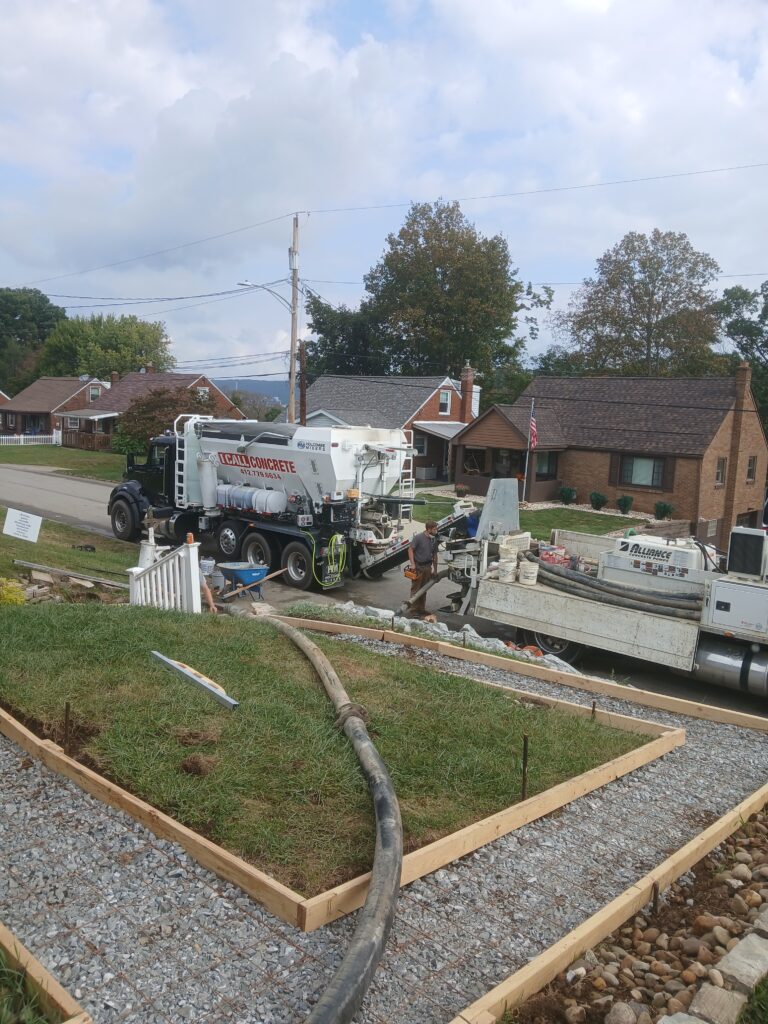
Why You Need a Local Pittsburgh Concrete Contractor
Local contractors understand the regional conditions that affect concrete performance, and that knowledge pays off on every project. Pittsburgh weather demands specific concrete mixes, additives, and pour timing to handle freeze-thaw cycles. Out-of-area contractors often use mixes designed for milder climates, leading to early failures. Our team sources materials from local suppliers who understand the regional requirements. That local supply chain produces concrete built for Pittsburgh, not for somewhere warmer. The performance difference shows after a few winters.
Permitting and code compliance also vary across the boroughs and townships in our service area. Bethel Park has different setback requirements than Mount Lebanon, and Ross Township handles drainage approvals differently than Penn Hills. Local contractors know these distinctions and handle the paperwork correctly the first time. Out-of-area contractors often hit permit delays that push project timelines back. RMK Concrete Services manages local compliance smoothly, keeping projects on schedule. Homeowners avoid the headaches of regulatory mistakes.
Service after the sale is another advantage of working with a local company. If a question or concern comes up six months or two years after the pour, we are right here to address it. Out-of-area contractors disappear after the truck rolls away, leaving homeowners without support. Need to plan a concrete project? Visit our driveway paving service page to learn more about our installation process. RMK Concrete Services builds relationships, not just slabs.
Why You Need RMK Concrete Services for Your Next Project
RMK Concrete Services is family-owned and operated with integrity at the core, and that approach shapes every project we take on. We treat every property like it belongs to a member of our own family, because reputation matters in this business. Free in-person estimates let homeowners see exactly what they are getting before any work begins. Veterans and seniors receive discounts as a thank-you for their contributions to our community. Licensed and insured status protects every customer we serve. Those fundamentals build trust.
Serving Pittsburgh and the surrounding 60-mile radius means we understand the full range of conditions homeowners face across the region. From Cranberry Township to Murrysville, from Moon Township to Plum, we have completed projects in nearly every neighborhood. That breadth of experience translates into better recommendations and smarter project planning for each customer. Our crews show up on time, work efficiently, and clean up thoroughly when the job is done. Professionalism shows in the small details.
Five-star service is the standard we hold ourselves to on every project, and customer reviews reflect that commitment. Call us at (412) 902-5114 or email info@rmkconcrete.com to schedule a free estimate. RMK Concrete Services handles driveways, patios, walkways, decorative work, repairs, and more across the Pittsburgh metro area. We are ready to help homeowners make the smart choice between concrete and pavers. Quality concrete work starts with a phone call. Let us show what experienced craftsmanship can do for your property.