
Standing water on a concrete driveway is more than an eyesore, and fall is the season when it turns into a real problem for Pittsburgh homeowners. Autumn brings steady rain, wet leaves that clog drainage paths, and the first hard freezes of the year, which means any puddle sitting on your slab in October is a puddle that will be freezing and thawing by December. Water that cannot drain works its way into the pores of the concrete surface, expands as it freezes, and slowly pushes the top layer apart from the inside. That process is what causes the flaking, pitting, and crumbling that so many driveways in Allegheny County show by their tenth or fifteenth winter. Pooling also signals something deeper, because concrete that holds water is almost always concrete that has settled, was poured at the wrong pitch, or sits on a base that never drained properly to begin with. The good news is that nearly every cause has a repair path, and most of them are far cheaper than a full tearout when they are addressed early. This guide walks through why water pools on driveways, what actually fixes it, and how to time the work before the ground freezes.
Why Water Is Pooling on Your Driveway
Concrete does not hold water because it is old; it holds water because it is no longer sloped the way it was designed to be sloped, or because it never had enough slope in the first place. A properly built residential driveway should shed water at roughly a quarter inch of fall per foot of run, which works out to about two percent. That amount is gentle enough that you barely notice it underfoot but steep enough that rain keeps moving instead of stopping. When that pitch is lost to soil settlement, poor finishing, or a landscape change around the edges of the slab, water finds the low spot and stays there. Understanding which of those causes is at work on your property matters, because the wrong repair on the right problem is money spent twice. A contractor who takes the time to shoot grades and read the drainage pattern will give you an accurate answer, and that is a very different conversation than a quote written from the curb.
Slope Problems That Cause Water Pooling on Your Driveway
Slope is the first thing to check, and it is the cause we find most often on driveways that have puddled since the day they were poured. Pittsburgh sits on hilly terrain, and installers working on an awkward grade sometimes flatten a section to make the transition to a garage floor or a street apron feel smoother to drive over. That flattened area becomes a shelf, and a shelf holds water. Another common version of the problem is negative pitch, where the slab actually falls back toward the house or the garage instead of away from it, which sends runoff straight to the foundation wall. You can test this yourself with a garden hose and ten minutes of patience, running water at the high end and watching where it stalls. A four foot level laid across the suspect area will tell you the rest of the story, since a bubble sitting dead center means you have no fall at all in that spot.
The tricky part about slope problems is that they are rarely uniform across a whole driveway. A slab can drain beautifully for thirty feet and then hold half an inch of water in a single ten foot square near the apron, which tells you the issue is localized rather than a design flaw in the original layout. Localized flat spots often trace back to the pour itself, where a screed board was pulled at a slightly different angle or a section was floated too aggressively while the mix was still wet. Full driveway negative pitch, on the other hand, usually points to a layout problem that was baked in at the forming stage. The distinction matters for cost, because a localized correction can sometimes be handled with lifting or a targeted replacement panel. A driveway that pitches the wrong direction end to end is a candidate for removal and repour, and no surface treatment will change that.
Landscaping changes are the quiet third cause, and homeowners are frequently surprised by this one. A new mulch bed, a raised paver border, a regraded lawn, or even years of accumulated soil buildup along the driveway edge can create a dam that traps water on a slab that used to drain fine. Concrete needs somewhere to send the water it sheds, and grass that has crept up over the edge of the slab by an inch will hold a shallow pond against the concrete every time it rains. The fix here is often as simple as cutting back the turf line and creating a shallow swale that carries runoff toward the street or a low corner of the yard. Downspouts deserve the same scrutiny, since a gutter that dumps directly onto the driveway will overwhelm even a well sloped slab during a heavy fall storm. Extending that discharge line past the edge of the concrete is one of the cheapest drainage improvements available to any homeowner. Planning a new driveway and want the pitch engineered correctly from the start? Click here for our driveway paving service.
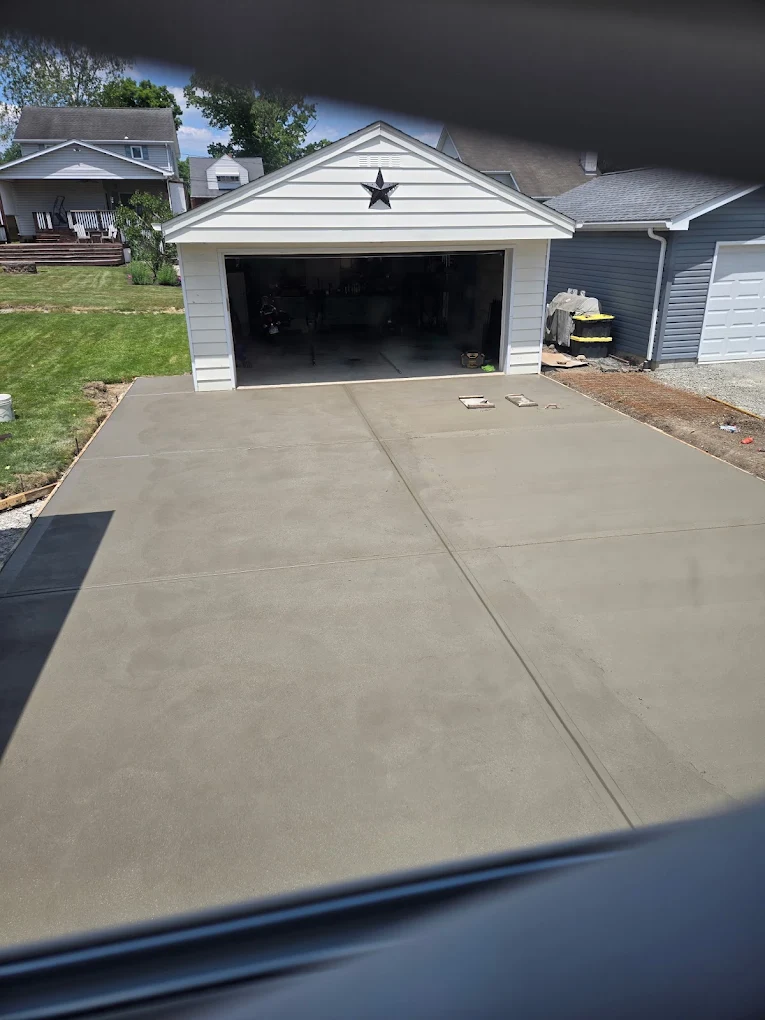
Settled Subgrade and Water Pooling on Your Driveway
When a driveway that used to drain properly starts holding water, settlement is usually the culprit, and settlement is a base problem rather than a concrete problem. Concrete is only as stable as the compacted material underneath it, which on a correctly built driveway means four to six inches of crushed stone placed over undisturbed or properly compacted soil. Western Pennsylvania has a great deal of heavy clay in its soil profile, and clay swells when it takes on water and shrinks when it dries out. That cycle repeats every season, and over ten or twenty years it can pull enough support out from under a slab to create a visible dip. Utility trenches are another frequent source, because backfill that was not compacted in lifts will continue consolidating for years after the work is done. If your low spot runs in a straight line across the driveway, there is a good chance a pipe or a conduit is buried directly beneath it.
Poor drainage in the base layer accelerates everything. Crushed stone is meant to let water pass through and move away, and when that stone is contaminated with fines or was never installed at all, the space under your slab holds moisture like a sponge. Saturated soil loses bearing capacity, which means the slab settles further, which means it holds even more water at the surface, which then soaks down through joints and cracks to make the base wetter still. This is a feedback loop, and it explains why a small birdbath that seemed harmless three years ago is now a puddle you can see from the street. Erosion works the same way when runoff is allowed to run along the edge of a slab and wash out the supporting material from the side. Once that undercutting starts, the edge of the driveway will crack and drop, often within a single wet season.
Settlement rarely stays contained to the driveway. Water that collects against a house because of a settled or reverse pitched slab is water that ends up in the soil against your foundation wall, and hydrostatic pressure does not need much of an opening to find its way into a basement. Homeowners who notice a damp corner in the basement after heavy rain should look at their exterior grading before they look anywhere else, since the source is frequently sitting in plain sight twenty feet away. Correcting driveway drainage is often the single most effective step in keeping a basement dry, and it is far less disruptive than interior work. The two issues are connected closely enough that we treat them as one conversation during an estimate. Seeing moisture in the basement after heavy rain? Click here for our basement waterproofing service.
Finishing Flaws and Drainage Blockages That Cause Water Pooling on Your Driveway
Not every puddle comes from settlement or slope, and some of them were placed there by the finishing crew on the day of the pour. Concrete flatwork is leveled with a screed and then refined with floats and trowels, and small depressions can be introduced at any point in that sequence. The industry has a rough tolerance for this, and a depression deeper than about a quarter inch measured under a ten foot straightedge is generally considered a defect rather than an acceptable variation. Shallow birdbaths of this type tend to appear near control joints, along edges, and in areas where a finisher had to reach across the slab. They usually hold a thin film of water rather than a deep puddle, and they dry out within a day or two after rain in warm weather. In November, that same film sits for a week and freezes twice.
Blocked drainage infrastructure creates puddles that have nothing to do with the concrete at all. Trench drains, catch basins, and area drains all rely on an unobstructed path to an outlet, and fall is the worst season for that path staying clear. Leaves, silt, roofing granules washed down from the gutters, and general yard debris will pack a drain grate solid in a single storm. Once the inlet is choked, water backs up onto the surrounding slab and behaves exactly like a slope problem, which sends plenty of homeowners chasing a repair they do not need. Pulling the grate and clearing the channel takes minutes and should be part of a fall routine on any property that has surface drainage installed. If the drain is clear and water still backs up, the outlet pipe or the connection downstream is the next place to look.
Cracks and open joints complicate the picture because they let surface water disappear rather than pool, which can make a drainage problem look better than it is. Water entering a crack goes straight into the base material, saturates it, and contributes to the settlement that will create a larger low spot later. Open control joints that have lost their sealant behave the same way, and on a driveway that is fifteen years old, most of the original joint filler is long gone. Sealing those joints with a flexible material keeps surface water on the surface where it can drain away as designed. It also keeps deicing salt out of the base, which matters a great deal in a region that salts heavily from December through March. Joint maintenance is inexpensive, quick, and one of the highest return tasks on a concrete driveway.
How to Fix Water Pooling on Your Driveway
The right repair depends entirely on the cause, and the range runs from a few hundred dollars of grading work to a full replacement. A settled section that is otherwise sound can often be raised back to grade without breaking anything. A slab poured at the wrong pitch cannot be corrected without removing concrete. Surface drains and regrading solve a specific category of problem and do nothing for another category, so the diagnosis has to come first. What follows is a breakdown of the methods that actually work, along with an honest look at when each one is appropriate. Any contractor recommending a single approach for every driveway is selling a product rather than solving a problem, and that is worth keeping in mind when you compare quotes this fall.
Concrete Lifting to Fix Water Pooling on Your Driveway
Concrete lifting, sometimes called slabjacking, raises a settled section back to its original elevation by injecting material into the void beneath it. The traditional version uses a cementitious slurry pumped through holes of roughly an inch and a half to two inches in diameter, and the modern version uses expanding polyurethane foam injected through holes closer to the size of a penny. Both approaches fill the empty space under the slab, and both then continue lifting the concrete once that space is full. Polyurethane cures within minutes and weighs a fraction of what a slurry weighs, which makes it a better choice over soft soils that settled under load in the first place. The slurry method costs less on large areas and remains a solid option where weight is not a concern. The right selection depends on soil conditions and the size of the void, which is something we determine on site.
Lifting is the ideal repair for a slab that is structurally sound but sitting at the wrong elevation, and that describes a large share of the pooling driveways we look at. The section has to be in one piece or close to it, with no severe cracking that would cause it to break apart under lifting pressure. Concrete that is already crumbling, heavily spalled, or fractured into multiple loose pieces is not a lifting candidate and should be replaced. A good rule of thumb is that a slab with one or two clean cracks can usually be lifted successfully, while a slab that looks like a mosaic cannot. Cost typically lands well below replacement for the same area, and the work is often finished in a single day. Driveways can generally take traffic again within hours when foam is used.
The important thing to understand about lifting is that it corrects elevation, not the underlying reason for the settlement. If the void was created by a leaking downspout, an eroding edge, or an uncompacted utility trench, that source needs to be addressed at the same time or the slab will settle again. Polyurethane foam has an advantage here, since it fills and stabilizes the soil void rather than simply pushing the concrete upward. Pairing a lift with an extended downspout, a repaired edge, or improved grading turns a temporary fix into a lasting one. We routinely handle both parts of that work in the same visit, because sending a crew back in two years helps nobody. Have a driveway with cracking and settlement that needs attention before winter? Click here for our concrete repair service.
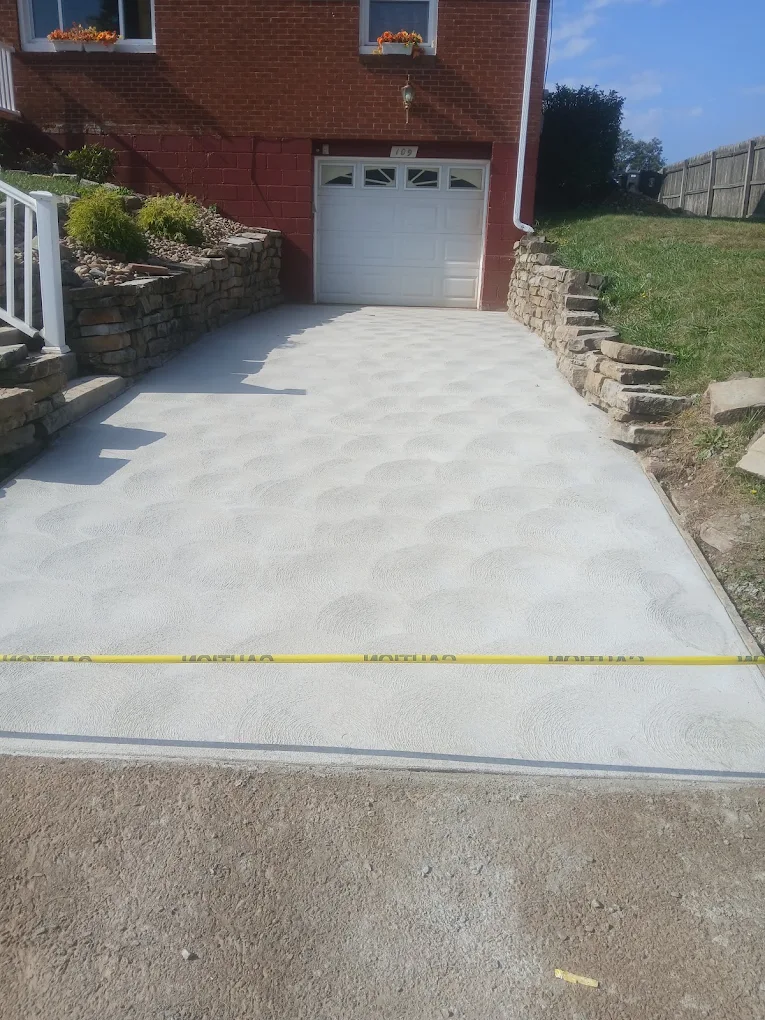
Drains and Grading That Fix Water Pooling on Your Driveway
Surface drainage is the answer when the water arriving at your driveway is more than the slope can carry away, which is common on sloped Pittsburgh lots where the driveway sits below the level of the yard. A trench drain, also called a channel drain, is a linear collector set flush with the concrete surface across the width of a driveway or along its low edge. It intercepts runoff before it reaches the garage or the low spot, then carries it through a solid pipe to a discharge point. Placement usually falls at the garage apron, at the base of a sloped run, or across a low corner where water naturally concentrates. Installation requires sawcutting the existing concrete, excavating the channel, setting the drain body at the correct elevation, and pouring back around it. The outlet has to go somewhere legal and functional, which means daylight at a lower point on the property or an approved storm connection rather than a sanitary line.
French drains handle a different job, collecting subsurface water rather than surface water. A perforated pipe is bedded in washed stone, wrapped in filter fabric, and run along the uphill side of a driveway to intercept groundwater before it saturates the base. This is the right tool when the soil beside your driveway stays soft and wet long after a rain, and it addresses the saturation that leads to future settlement. The filter fabric matters more than most homeowners realize, since a French drain without it silts up and stops working within a few years. Slope matters too, and a minimum fall of about one percent along the pipe keeps water moving toward the outlet. Combining a French drain with a surface drain covers both categories of water on a difficult lot.
Regrading is the least expensive option and often the most overlooked. Cutting a shallow swale in the lawn beside the driveway, lowering a soil line that has crept above the slab edge, or building a low retaining wall to hold back an uphill bank can redirect enough runoff to eliminate a puddle entirely. Downspout extensions belong in the same category, and running that discharge at least six to ten feet away from the slab and the foundation is standard practice. Yard work of this type can frequently be completed in a day and costs a fraction of any concrete repair. We always look at these options first during an estimate, because recommending a large project when a small one will solve the problem is not how we want to do business. Not every driveway can be fixed this way, but the ones that can should be.
Replacement and Resurfacing to Fix Water Pooling on Your Driveway
Replacement becomes the correct answer when the slab has failed structurally or when the original pitch was wrong across the entire driveway. There is no way to add slope to concrete that runs the wrong direction without removing it, and thin patching compounds feathered out over a low spot will break loose within a season or two. A properly rebuilt driveway starts with excavation to the correct depth, followed by four to six inches of compacted crushed stone placed in lifts and compacted mechanically rather than driven over with a truck. The slab itself should be at least four inches thick for standard passenger vehicles and five to six inches where heavier trucks park regularly. Control joints get cut at spacing roughly equal to twenty four to thirty times the slab thickness in inches, meaning eight to ten feet apart on a four inch driveway, at a depth of about a quarter of the slab thickness. Getting these details right is the difference between a driveway that lasts thirty years and one that starts pooling again in eight.
Concrete mix design deserves attention in a climate like ours. Exterior flatwork in a freeze thaw region should be air entrained, generally in the range of five to seven percent air content, which creates microscopic voids that give freezing water somewhere to expand. Without that air content, the same freeze that a properly specified slab shrugs off will pop the surface apart within a few winters. Compressive strength for residential driveways in this region commonly falls in the four thousand pound per square inch range, and we specify accordingly. Finishing also matters, since a broom finish provides traction and drains better than a slick troweled surface. New concrete needs roughly twenty eight days to reach design strength, and it should not be sealed until that curing period is complete.
Resurfacing occupies a narrow middle ground and gets oversold constantly. A bonded overlay can correct minor surface irregularities and refresh appearance on a slab that is otherwise sound and correctly pitched, and it needs adequate thickness with proper surface preparation to bond reliably. What it cannot do is fix settlement, restore lost slope across a large area, or hold together over a slab that is actively cracking. An overlay applied over a failing driveway will telegraph every crack beneath it and delaminate at the edges, usually within the first two winters. We will tell you plainly when a driveway is a resurfacing candidate and when it is not, because the wrong recommendation here wastes real money. Sealing is a separate matter and worth doing on any sound driveway, with a penetrating silane siloxane product reapplied every two to three years.
Why You Need a Professional to Stop Water From Pooling on Your Driveway
Diagnosing driveway drainage correctly takes measurement, not guesswork, and the cost of guessing wrong is a repair that fails during the first hard freeze. A contractor with the right equipment can shoot elevations across the slab, identify the exact depth and extent of a low area, and trace where runoff is originating before recommending anything. That process also catches problems homeowners miss, like a settled apron that is pushing water toward a foundation wall or an outlet pipe that failed years ago. Fall is the window for this work in Pittsburgh, since concrete needs above freezing temperatures to cure and the ground needs to be workable for any excavation. Waiting until spring means one more winter of water freezing in your slab and widening every crack it can reach. A free in person estimate now costs nothing and tells you exactly where you stand.
Fall Timing Matters When You Stop Water From Pooling on Your Driveway
September and October are the strongest months of the year for driveway drainage work in Western Pennsylvania. Ground temperatures are still warm, soil is workable for excavation and grading, and daytime highs stay comfortably in the range concrete needs for a proper cure. Once nighttime lows start dipping below freezing regularly, new concrete requires blankets, heated enclosures, or admixtures that add cost to the job. Scheduling also gets tighter as the season progresses, since every contractor in the region is trying to finish flatwork before the weather closes the window. Booking early in the fall gives you options on timing that simply do not exist in late November.
The seasonal argument goes beyond convenience, because standing water on concrete is genuinely more destructive in winter than at any other time of year. Water in the pores of a concrete surface expands by roughly nine percent when it freezes, and our region delivers dozens of freeze and thaw cycles between December and March. Each cycle applies internal pressure that gradually separates the top layer of paste from the aggregate below it, which shows up as scaling and flaking in the spring. Deicing salts compound the damage by increasing the number of freeze cycles a surface experiences and by drawing additional moisture into the slab. A puddle you tolerate this fall becomes visible surface damage by April.
Fall also happens to be the moment when drainage problems are easiest to observe. Autumn rain arrives frequently enough that you can watch how your driveway behaves under real conditions without waiting for a storm, and falling leaves reveal every clogged drain and blocked outlet on the property. Walking the driveway after a rainfall and marking the spots that hold water gives a contractor exactly the information needed for an accurate assessment. Take a few photos while the water is still standing, since the evidence disappears once things dry out. That five minutes of observation makes your estimate more precise and your repair more targeted.
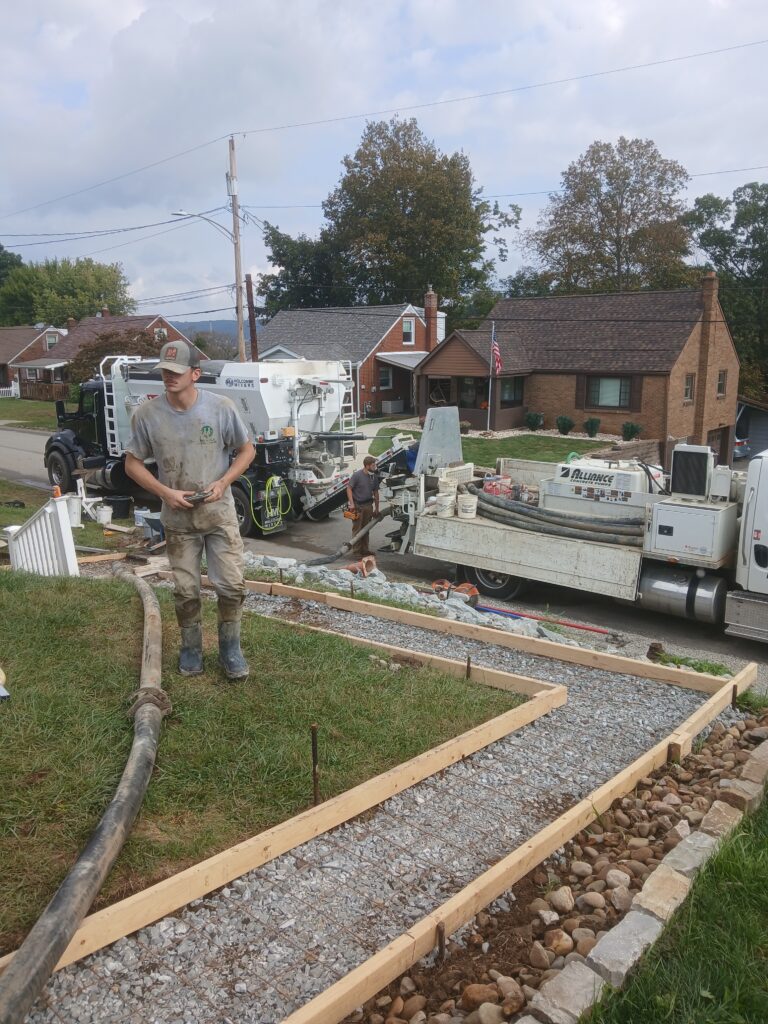
What to Expect From an Estimate to Stop Water From Pooling on Your Driveway
A proper estimate begins with a walk of the entire drainage path, not just the puddle. We look at where water enters the property, how it travels, where it concentrates, and where it is supposed to exit, because a puddle at the bottom of a driveway is usually the last chapter of a longer story. Elevations get measured across the slab so the depth and extent of any low area is documented rather than estimated. Existing drains, downspouts, joints, cracks, and edge conditions all get inspected, since any one of them can be the actual source. Only after that does a repair recommendation make sense.
You should expect a written proposal that names the specific work, the materials involved, and the price, with no vague line items standing in for real scope. If more than one approach could solve the problem, we will lay out the options and explain the tradeoffs in cost and longevity so you can make the call. We will also tell you when a repair is not urgent, because a shallow birdbath that dries within a day is a different situation than a two inch pool sitting against your garage. Honest scoping means some estimates end with a recommendation to do very little. That is a fair outcome and we are comfortable with it.
Every estimate we provide is free and delivered in person, which is the only way to assess drainage with any accuracy. Phone quotes and satellite images cannot show you a quarter inch of reverse pitch or a soft spot in the soil along a slab edge. We serve Pittsburgh and a 60 mile radius, including Bethel Park, Ross Township, Monroeville, Mount Lebanon, Cranberry Township, and communities throughout the region. Veterans and seniors discounts are available on all of our work. Reaching us takes one phone call at (412) 902-5114 or an email to info@rmkconcrete.com.
Why Choose RMK Concrete Services to Stop Water From Pooling on Your Driveway
RMK Concrete Services is a family owned and operated company built on doing the work correctly rather than quickly. We are licensed and insured, and we approach every driveway with the understanding that the base, the pitch, and the mix matter more than anything visible on the surface. Integrity sits at the core of how we operate, which in practice means telling homeowners the truth about what their driveway needs even when the honest answer is a smaller job than expected. That approach has built our reputation across Pittsburgh over years of referrals from neighbors who trusted us first.
Our crews work in this climate year after year and understand exactly what Western Pennsylvania weather does to concrete. Air entrainment, proper joint spacing, compacted stone base, correct slope, and appropriate sealing are not optional details in a region with this many freeze cycles; they are the reason a driveway survives. We specify and install to those standards on every project, from a single settled panel to a complete replacement. When a job calls for drainage work rather than concrete work, we say so and handle it accordingly.
We are dedicated to providing five star service on every project, and that commitment shows up in the small things as much as the large ones. Crews arrive when scheduled, sites get cleaned up daily, and we stay reachable from the first estimate through the final walkthrough. Beyond driveways, we handle patios, sidewalks, steps, retaining walls, foundations, decorative concrete, sealing, and snowplowing throughout the greater Pittsburgh area. Call (412) 902-5114 to schedule your free in person estimate and get your driveway draining properly before the first freeze arrives.