
Late summer gives Pittsburgh homeowners the best window of the year to pour new concrete. Temperatures are warm but starting to settle, humidity begins to drop, and rain becomes less frequent than it was in June and early July. Concrete cures best when daytime highs sit between 60 and 80 degrees, and August through September delivers those numbers consistently in Western Pennsylvania. Contractors also have clearer schedules once the spring rush fades, which means faster start dates and more attention on your project. Waiting until fall risks cold snaps that complicate curing; waiting until next spring means another winter of freeze and thaw damage on your existing surfaces. The ground is dry and stable right now, and that matters for driveways, patios, sidewalks, and foundations alike. If you have been putting off a concrete project, the calendar is telling you to act. This article explains why late summer conditions produce stronger, longer lasting concrete and how to plan your project before the season closes.
Why Late Summer Weather Creates Ideal Concrete Curing Conditions
Concrete does not simply dry; it cures through a chemical reaction called hydration, and that reaction depends heavily on temperature and moisture. Late summer in Pittsburgh offers the steadiest conditions of the entire year for this process. Daytime temperatures stay warm enough to keep hydration moving at a healthy pace, while cooler nights prevent the rapid moisture loss that plagues pours in the peak heat of July. Rainfall totals drop noticeably in August and September, which lowers the risk of a storm ruining a fresh slab. Soil moisture levels also stabilize, giving your sub base a firm, predictable foundation. All of these factors combine to produce concrete that reaches its full design strength with fewer defects. Understanding the science behind curing helps you see why timing is not just a scheduling detail; it is a quality issue.
How Late Summer Temperatures Improve Concrete Curing Strength
Concrete gains strength fastest and most completely when ambient temperatures hold between 60 and 80 degrees Fahrenheit. In Pittsburgh, late August and September deliver this range almost daily, which is why contractors consider it prime pouring season. When temperatures climb above 90 degrees, water evaporates from the surface of the slab faster than the hydration reaction can use it, and that leads to shrinkage cracks, surface scaling, and weakened top layers. Early summer pours often require constant misting, evaporation retarders, and shade structures just to keep the slab workable. Late summer removes most of that risk because the sun sits lower and the air holds less punishing heat. The result is concrete that cures evenly from top to bottom without emergency interventions.
Cold weather creates the opposite problem, and it arrives in Pittsburgh sooner than many homeowners expect. Once overnight temperatures dip below 40 degrees, hydration slows dramatically, and fresh concrete that freezes within the first 24 hours can lose up to half of its potential strength permanently. October pours in Western Pennsylvania are a gamble because a single early cold front can compromise an entire slab. Contractors can use blankets, heated enclosures, and accelerating admixtures, but those measures add cost and still carry risk. Late summer pours avoid the problem entirely because the slab reaches its critical early strength long before the first frost. That timing cushion is one of the biggest advantages of scheduling now.
Strength gains in the first seven days determine much of a slab’s long term performance. Concrete typically reaches about 70 percent of its design strength within that first week under ideal conditions, and late summer provides exactly those conditions. A driveway poured in late August will be fully cured, sealed, and ready before winter salt and plows arrive. A patio poured in September still has weeks of mild weather to harden properly before the first freeze. Compare that with a spring pour, where cold soil and frequent rain stretch cure times and delay use of the surface. Homeowners who pour in late summer get a stronger product and faster access to it. Timing the pour to the weather is the cheapest quality upgrade available.
Why Lower Humidity in Late Summer Helps Concrete Cure Evenly
Humidity affects concrete curing in ways most homeowners never consider, and Pittsburgh’s late summer humidity drop is a genuine advantage. High humidity in June and July slows surface evaporation unevenly, which can cause the top of a slab to cure at a different rate than the interior. That mismatch creates internal stress, and internal stress eventually shows up as cracking, curling at the edges, or a dusty, weak surface. Late summer air is drier and more consistent, so moisture leaves the slab at a steady, predictable rate. Finishers can time their troweling and edging work accurately because the bleed water behaves the way it should. Consistent evaporation means consistent strength across the entire pour. The finish quality on a late summer slab is simply easier to control.
Drier air also improves the performance of curing compounds and sealers. These products need to bond to the surface and form a continuous film, and excess ambient moisture interferes with both steps. A sealer applied in humid July conditions can trap moisture underneath, leading to a cloudy, blotchy appearance that ruins the look of decorative work. In late summer, sealers flash off cleanly and cure hard, giving your new driveway or patio maximum protection heading into winter. This matters enormously in Pittsburgh, where road salt and freeze thaw cycles attack unsealed concrete within the first season. A properly sealed late summer pour enters winter fully armored. Want that protection on an existing surface too? Click here for our concrete sealing service.
Stable humidity also benefits colored and stamped concrete more than plain gray flatwork. Decorative concrete relies on color hardeners, release agents, and integral pigments that all react to moisture in the air. Uneven humidity produces uneven color, and no homeowner wants a patio with blotchy tones baked permanently into the surface. Late summer conditions let pigments develop uniformly and let stamping crews work the surface at exactly the right window of plasticity. The difference between a decorative pour finished in ideal weather and one fought through humidity is visible for the life of the slab. Photographs of late summer decorative pours consistently show richer, more even color. If curb appeal is part of your goal, the season matters even more.
How Dry Late Summer Soil Conditions Protect Your Concrete Pour
The ground beneath your concrete matters as much as the concrete itself, and late summer soil is at its most stable point of the year. Spring pours in Pittsburgh contend with soil saturated by snowmelt and heavy rain, and wet soil compacts poorly. A sub base that shifts or settles after the pour will crack the slab above it no matter how well the concrete was mixed. By August, months of warm weather have dried the ground to a firm, workable state. Excavation crews can grade accurately, compaction equipment achieves proper density, and the gravel base locks together the way engineers intend. Stable ground is the invisible foundation of every long lasting driveway, patio, and walkway.
Dry conditions also make excavation faster and cleaner, which saves homeowners money and headaches. Wet spring soil clings to equipment, ruts the lawn, and turns a two day job into a four day mess. Late summer digs produce clean edges, minimal lawn damage, and predictable timelines. Drainage assessment is more accurate as well, because contractors can see how the site naturally sheds water without spring runoff distorting the picture. Proper slope and drainage planning prevents the pooling that destroys concrete over time. Projects involving grade changes, like steps or retaining walls, benefit even more from firm soil. Every phase of the job runs smoother when the ground cooperates.
Foundation and structural work sees the biggest gains from dry late summer soil. Footings for retaining walls, stairs, and building foundations must bear on undisturbed, properly compacted earth, and saturated soil makes that standard hard to meet. Pittsburgh’s hillside lots are notorious for expansive clay that swells when wet and shrinks when dry; pouring against clay at its dry, stable state reduces future movement. Waterproofing membranes and drainage board also adhere better to dry foundation walls. Inspections pass faster because inspectors can actually see clean, dry excavations. If your project involves footings or walls, late summer is not just convenient, it is structurally smarter. Click here for our concrete foundations service to get that work scheduled while conditions hold.
What Concrete Projects to Schedule in Late Summer Before Winter Arrives
Not every concrete project carries the same urgency, but several types absolutely need to be finished before Pittsburgh’s first freeze. Driveways, sidewalks, and patios poured now will be fully cured and sealed before snow and salt season begins. Repair work on cracked or spalling surfaces should happen immediately, because every existing crack becomes a freeze thaw wedge once water enters and ices over. Foundation and basement waterproofing projects also belong on the late summer list, since dry soil makes excavation practical and winter makes it nearly impossible. Homeowners who plan now get on contractor schedules before the fall rush fills every remaining slot. The projects below deserve the top of your list. Each one becomes harder, riskier, or flatly impossible once cold weather locks in.
Late Summer Is the Best Time for Driveway Paving Projects
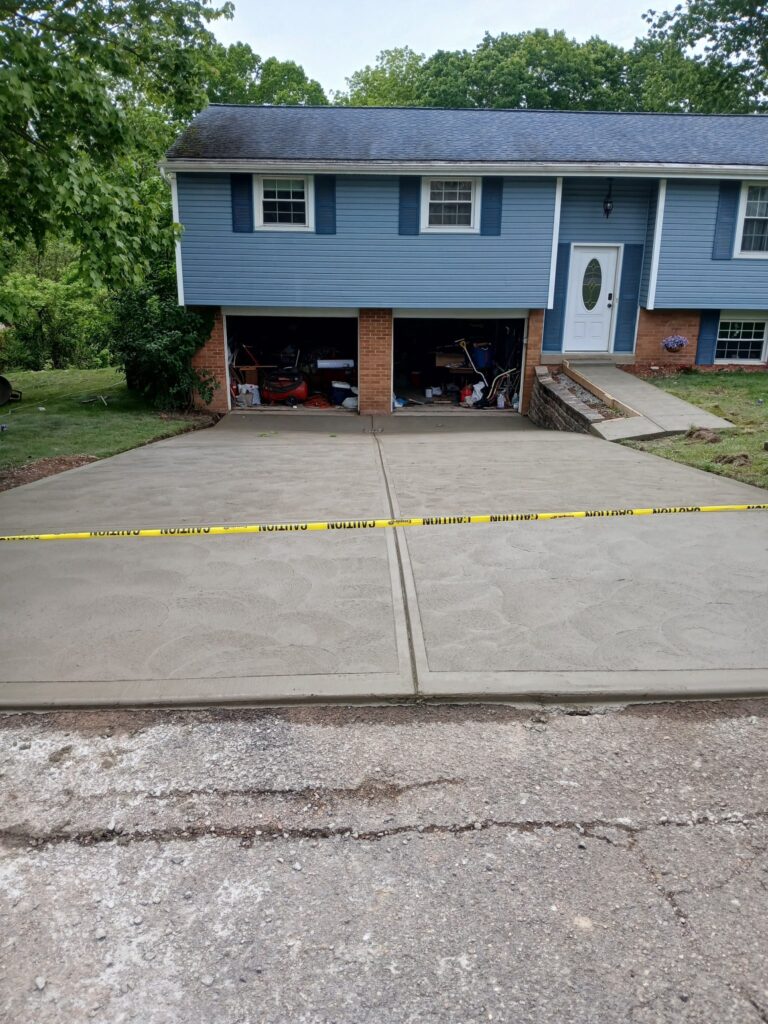
A concrete driveway is the largest flatwork investment most homeowners make, and late summer is the smartest time to pour it. The slab needs roughly 28 days to reach full design strength, and it should receive its first sealer application before facing road salt and plow blades. An August or September pour completes that entire timeline with weeks to spare before Pittsburgh’s first hard freeze. Spring pours face the opposite math; the driveway cures through unpredictable weather and then endures summer heat stress in its first months. Late summer driveways enter winter at full strength with fresh sealer protection. That head start translates directly into a longer service life. Ready to replace that cracked driveway? Click here for our driveway paving service.
Existing driveways showing damage need attention now, not in spring. Every crack, no matter how small, admits water into the slab and the base below it. When that water freezes, it expands about nine percent in volume and pries the crack wider with every cycle. Pittsburgh averages dozens of freeze thaw cycles per winter, which is why a hairline crack in September becomes a gaping fault line by March. Repairing cracks and joints in late summer, then sealing the surface, stops that cycle before it starts. The cost difference between a fall repair and a spring replacement can reach thousands of dollars. Preventive work in this season pays for itself many times over.
Timing your driveway project now also means you actually get to use it before winter. Concrete needs about a week before light vehicle traffic and closer to a month before heavy loads, and late summer weather makes those milestones arrive on schedule. Your new driveway will be ready for holiday guests, winter deliveries, and daily parking without restrictions. Curb appeal improves immediately, which matters if a home sale is anywhere in your future plans. Fresh concrete photographed against green grass sells better than concrete surrounded by snow. Practical use and property value both argue for pouring now. The season rewards homeowners who act before Labor Day passes.

Why Patio Paving Belongs on Your Late Summer Project List
A new concrete patio poured in late summer gives you immediate enjoyment and long term durability in one move. You still have warm evenings in September and often into October in Pittsburgh, so the patio earns its keep right away with cookouts, fire pit nights, and outdoor dinners. The slab cures under ideal conditions while you plan furniture and lighting. By the time winter arrives, the surface is fully hardened and sealed against snow load and freeze cycles. Homeowners who wait until spring lose an entire season of use and pour into wetter, less predictable conditions. The math favors acting now on both enjoyment and quality. Click here for our patio paving service to get a free in person estimate.
Late summer is also the prime window for decorative patio finishes. Stamped patterns, exposed aggregate, and integral color all demand precise timing during the finishing stage, and stable weather makes that precision achievable. Color hardeners develop richer, more uniform tones when humidity is moderate and rain is unlikely. Stamping crews can work the surface at exactly the right firmness instead of racing a thunderstorm or fighting rapid evaporation. Sealer applied over decorative work in dry September air cures glassy and clear, locking in the color for years. A decorative patio is a design investment, and the season protects that investment. Poor weather during finishing is the number one cause of disappointing decorative results.
Planning a patio in late summer also lets you coordinate related hardscape elements in a single mobilization. Steps from the back door, a walkway to the driveway, and a small retaining wall for a sloped yard can all be formed and poured in the same project window. Combining scopes saves on equipment, excavation, and labor costs compared with piecemeal projects spread across seasons. Dry soil makes the grading for all of these elements accurate and stable. Your yard is disturbed once instead of repeatedly. The finished result looks cohesive because everything was designed and poured together. One well timed late summer project can transform an entire backyard before the leaves fall.
Late Summer Concrete Repair Stops Winter Freeze Thaw Damage
Concrete repair is the most time sensitive project on this list, because winter actively punishes every flaw you leave unaddressed. Cracks, spalls, chipped edges, and settled slabs all collect water, and Pittsburgh winters turn that water into a demolition tool. Freeze thaw cycling widens cracks, lifts slab sections, and breaks surface layers loose in sheets. Repairs made in late summer cure fully and seal tightly before the first freeze, closing every entry point for water. Repairs attempted in cold weather often fail because patching materials cannot bond or cure properly below 50 degrees. The window for reliable repair work closes in October. Acting in August or September is the difference between a small fix and a major replacement.
Walk your property now and inventory every concrete surface honestly. Look for cracks wider than a credit card, edges flaking near downspouts, steps with loose or chipped treads, and sidewalk sections that have heaved or settled out of level. Uneven sidewalk joints are trip hazards that create real liability for homeowners, and settled sections only worsen as winter frost pushes soil around. Garage floor cracks admit water that freezes and widens them beneath parked vehicles. Basement wall cracks deserve special attention because they signal water intrusion paths that winter will exploit. A written list makes your estimate conversation faster and ensures nothing gets missed. Most homeowners find more damage than they expected once they actually look.
Professional repair in late summer uses the season’s advantages at every step. Cleaned and routed cracks dry completely before fillers go in, which is essential for bond strength. Polymer patching compounds and resurfacing overlays cure at their rated speeds in warm, dry air. Full depth replacements of failed sections benefit from stable sub base soil and fast concrete strength gain. After repairs cure, a penetrating sealer over the entire surface blocks salt and water for the coming winter. This repair and seal combination is the single most effective winter preparation any concrete surface can receive. Need cracks fixed before the freeze? Click here for our concrete repair service.
Why You Need to Schedule Your Late Summer Concrete Project Now
The late summer window is real, but it is also short and fills quickly. Pittsburgh contractors watch the same weather calendar you do, and their schedules load up fast once homeowners realize fall is approaching. Booking now secures your spot while conditions remain ideal, and free estimates cost you nothing but a phone call. Every week of delay pushes your pour closer to unpredictable October weather and crowded schedules. Material availability and crew capacity are both at their best right now. The homeowners who call in July and August get the best of the season; the ones who call in October often get told to wait until spring.
The Cost of Waiting on Concrete Projects Until Spring
Delaying a concrete project until spring almost always costs more than acting now. Existing damage does not pause for winter; it accelerates through every freeze thaw cycle. A crack repair that costs a few hundred dollars in September can become a slab replacement costing thousands by April. Material prices in the construction industry have trended upward year over year, so next season’s pour will likely carry a higher price tag. Spring also brings the busiest demand of the year, which means longer waits and less scheduling flexibility. Waiting is not neutral; it is an expense.
Winter itself creates costs for homeowners with damaged concrete. Uneven sidewalks buried under snow become serious trip and fall hazards for family members and mail carriers alike. Cracked driveways trap ice that makes shoveling harder and salting less effective. Salt penetrating unsealed or damaged surfaces attacks the concrete matrix and any reinforcing steel inside it. Water entering foundation cracks can freeze and worsen basement leaks at the worst possible time of year. Each of these problems traces back to work that could have been finished in late summer.
Spring pours also face inherent quality challenges that late summer avoids. Melting snow saturates the ground, making sub base compaction unreliable well into May. Rain interrupts schedules and can damage fresh finishes. Cold snaps in April still threaten overnight curing temperatures. Contractors manage these risks constantly, but management is not the same as elimination. Late summer removes the risks instead of managing them. The best concrete is poured when the calendar is on your side.

How to Plan Your Late Summer Concrete Project the Right Way
Start with a free in person estimate, because concrete projects cannot be priced accurately over the phone. Site conditions, access for trucks, existing slab thickness, drainage patterns, and soil type all affect the scope. A professional walkthrough catches issues that photos miss, like hidden settlement or drainage problems feeding the damage. RMK Concrete Services provides free in person estimates on all projects, so there is no cost to getting real numbers. Bring your list of concerns and your goals for the space. A thorough estimate is the foundation of a project with no surprises.
Decide on finishes and options before the pour date, not during it. Choices like broom finish versus stamped texture, integral color, saw cut joint patterns, and sealer type all need to be locked in ahead of time. Decorative options add lead time for materials, so early decisions keep your project inside the late summer window. Ask about concrete thickness, reinforcement, and base preparation in writing. Good contractors welcome those questions because the answers separate quality work from cheap work. Clear decisions up front produce a smooth pour day.
Build a realistic timeline that accounts for curing, not just pouring. Plan for the slab to be off limits to foot traffic for a day or two and vehicles for about a week. Full strength arrives around 28 days, and sealing typically follows the initial cure. Work backward from Pittsburgh’s typical first frost and you will see why an August or early September start is the sweet spot. Add a buffer for weather days and permit timing if your project needs approvals. Projects planned with honest timelines finish calm; projects rushed against the frost date finish stressed.
Why Choose RMK Concrete Services for Your Late Summer Project
RMK Concrete Services is a family owned and operated company with integrity at the core of every project. We are fully licensed and insured, which protects your property and your investment from the first shovel to the final sealer coat. Our team serves Pittsburgh and a 60 mile radius, so we know exactly how Western Pennsylvania weather and soil behave. That local knowledge shapes every base we compact and every slab we pour. When we recommend a late summer pour, it comes from years of watching what our climate does to concrete. You get honest advice, not upselling.
We make quality concrete accessible to every homeowner in our service area. Free in person estimates on all projects mean you get accurate pricing with zero obligation. Veterans and seniors discounts are available because we believe in taking care of the people who have taken care of others. We walk every site personally, explain our recommendations in plain language, and put the scope in writing. There are no surprise charges and no vague promises. Our reputation across Pittsburgh was built one straightforward project at a time.
We are dedicated to always providing a 5 star service, and that standard shows up in the details. Clean job sites, on time crews, proper base preparation, and finishes done right the first time are non negotiable for us. From driveways and patios to foundations, repairs, and decorative work, our crews bring the same care to every pour. The late summer calendar is filling now, and we want your project on it while conditions are perfect. Call RMK Concrete Services at (412) 902-5114 or email info@rmkconcrete.com to schedule your free estimate. Let this be the season your concrete gets done right.